Staff Reporter
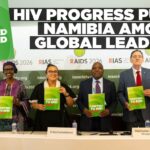
NEW UNAIDS data has placed Namibia among only 11 countries worldwide to achieve the global 95-95-95 HIV targets, while warning that funding cuts, widening inequalities and threats to human rights could derail efforts to end AIDS as a public health threat by 2030.
The recognition comes in the UNAIDS Global AIDS Update, launched during the 26th International AIDS Conference (AIDS 2026) in Rio de Janeiro, Brazil, where the Southern African Development Community (SADC) reaffirmed its commitment to strengthening regional cooperation and country-led HIV responses.
According to the report, Namibia exceeded the global targets in 2025, with 97% of people living with HIV knowing their status, 98% of those diagnosed receiving antiretroviral treatment, and 98% of those on treatment achieving viral suppression.
Among men, 94% knew their status, 97% of those diagnosed were on treatment and 97% achieved viral suppression. Women exceeded the targets, with more than 98% knowing their status and receiving treatment, while 98% achieved viral suppression.
The report, however, identified a significant gap among children aged 0 to 14 years. While 90% knew their HIV status, only 69% of those diagnosed were receiving treatment, although 94% of those on treatment had achieved viral suppression.
The UNAIDS report describes the global HIV response as being at a “critical turning point”. Although new HIV infections and AIDS-related deaths have fallen to their lowest levels in three decades, the organisation warned that progress is under threat from declining international funding.
External financing for HIV programmes in low- and middle-income countries fell by 18% in 2025 compared with the previous year, leaving available resources at US$17.6 billion—around US$4.3 billion short of the annual funding required to stay on track to end AIDS by 2030.
The report also highlighted the growing burden of debt on many African countries, noting that 28 countries on the continent now spend more on debt servicing than on public health.
Globally, UNAIDS reported that new HIV infections declined to 1.2 million in 2025, representing a 42% reduction since 2010, while AIDS-related deaths dropped to 570 000, down 57% over the same period.
By the end of 2025, 32.1 million people worldwide were receiving life-saving HIV treatment, representing 78% of all people living with the virus.
The report also warned of persistent inequalities, particularly among adolescent girls and young women in sub-Saharan Africa, where around 3 000 new HIV infections occur every week. It further noted that only 55% of children living with HIV globally are on treatment, compared with 78% of adults.
Speaking during the conference, SADC Senior Programme Officer for HIV and AIDS Dr Lamboly Kumboneki outlined the region’s progress in implementing the Global AIDS Strategy 2026–2031.
He said the 16-member regional bloc, which carries approximately 44% of the global HIV burden, continues to demonstrate leadership in the global HIV response.
Kumboneki highlighted that seven SADC member states have achieved the 95-95-95 targets and said the region is strengthening sustainable financing, pooled procurement, resilient health systems and local pharmaceutical manufacturing as part of its long-term HIV response.
The SADC Secretariat said the launch of the UNAIDS Global AIDS Update reinforced the importance of sustained investment, stronger regional collaboration and country-led responses to achieve the goal of ending AIDS as a public health threat by 2030.
UNAIDS concluded that ending AIDS remains within reach, but warned that governments and development partners must make renewed political and financial commitments to protect three decades of progress and prevent a resurgence of the epidemic.
Photos: SADC