Staff Reporter
SADC ministers responsible for politics, defence and security have convened in Salima, Malawi, to review regional peace and security, with conflicts in the Democratic Republic of Congo (DRC), terrorism, organised crime, cybercrime and governance among the key issues on the agenda.
The 28th Ordinary Meeting of the SADC Ministerial Committee of the Organ on Politics, Defence and Security Cooperation, held on Thursday, brought together foreign ministers, senior officials and security chiefs from across the region to assess progress on regional security programmes and strengthen cooperation in conflict prevention and peacebuilding.
Opening the meeting, SADC Executive Secretary Elias Magosi said Southern Africa remained one of the continent’s most peaceful and resilient regions, but warned that peace and security could not be taken for granted.
“As we meet today, we do so with both pride and purpose. Pride, because our region remains one of the most peaceful and resilient regions on our continent. And purpose, because peace, security and prosperity can never be taken for granted,” Magosi said.
He described the ongoing conflict in eastern DRC as a matter of “profound concern”, extending condolences to families affected by the violence and humanitarian crisis.
Magosi said insecurity in eastern DRC continued despite diplomatic efforts under the African-led mediation process and reiterated SADC’s support for restoring peace, protecting civilians and strengthening resilience against public health emergencies, including recurring Ebola outbreaks.
He also highlighted political developments in Madagascar, saying SADC had intensified mediation efforts through fact-finding missions, shuttle diplomacy and the work of the SADC Panel of Elders to promote dialogue and constitutional stability.
Magosi commended former Malawian President Joyce Banda for her leadership in supporting Madagascar’s reconciliation process.
Turning to Mozambique, he welcomed progress following the signing of the Political Commitment for an Inclusive National Dialogue, describing it as an important step towards reconciliation and nation-building.
While acknowledging that isolated terrorist attacks continue in Cabo Delgado Province, Magosi said the return of displaced communities and the revival of economic activity were encouraging signs that should be supported through continued regional cooperation and investment.
Beyond traditional security threats, Magosi warned that climate change, food and energy insecurity, cybercrime, terrorism, transnational organised crime and shifting geopolitical dynamics increasingly pose risks to regional stability.
He said ministers would consider measures to strengthen cooperation in mediation, conflict prevention, defence, migration management, anti-corruption initiatives, counter-terrorism and humanitarian response.
Magosi also reported progress in preserving the region’s liberation history, saying research documenting the contributions of SADC’s nine founding leaders had been completed ahead of the publication of a commemorative compendium.
He further welcomed growing support for the annual Southern Africa Liberation Day, observed on 23 March.
On regional integration, Magosi said SADC continued to make progress towards introducing the SADC Tourism UNIVISA, which would allow visitors to travel across participating member states using a single visa.
He added that 15 SADC member states had already adopted 90-day visa facilitation measures aimed at boosting tourism, trade and regional integration.
Magosi also called for stronger action against corruption, drug trafficking, human trafficking, illegal mining, illicit weapons, cybercrime and attacks on critical infrastructure, saying these challenges required closer intelligence-sharing and coordinated regional responses.
Meanwhile, Malawi’s Minister of Foreign Affairs and International Cooperation, George Chaponda, who chairs the Ministerial Committee of the Organ, said the meeting comes at a time when the regional and global landscape continues to evolve rapidly.
He said SADC had made significant progress in promoting peace, democratic governance and regional cooperation but stressed that sustaining those achievements would require continued vigilance, dialogue and collective action.
Chaponda urged member states to approach the deliberations with unity and a commitment to practical solutions that strengthen regional peace, security and stability.
The meeting is expected to conclude with decisions aimed at enhancing cooperation among member states in addressing emerging security threats and promoting peace, democratic governance and sustainable development across Southern Africa.
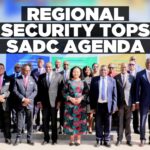
Photo: SADC