Staff Reporter
NAMIBIA produces approximately 371,800 metric tonnes of mahangu each year, fulfilling only 52% of the country’s demand, with the remainder having to be imported.
This was revealed by Patrice Talla, the Food and Agriculture Organisation (FAO) Interim Representative in Namibia, during the official launch of the “Support to Improve Productivity and Value Chain Development of Pearl Millet (mahangu) in Namibia” Project under the One Country, One Priority Commodity Initiative (OCOP) in Oshakati.
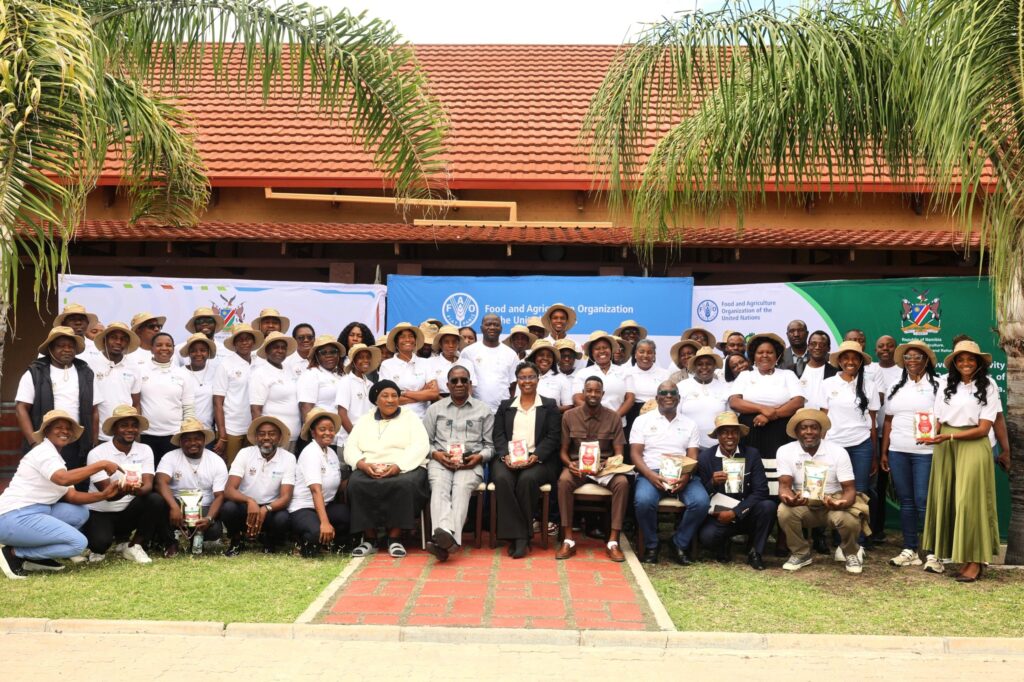
LAUNCHED: Scenes from the project launch. Photo: Ministry of Agriculture.
“Mahangu is the primary cereal for more than 60% of Namibians. It is a controlled crop under the Agronomic Industry Act. Yet Namibia’s own production, estimated at around 371,800 metric tonnes annually, meets only 52% of national demand. We import the rest. In 2022/23, following a severe drought, production fell to just 36,100 metric tonnes, down from 44,100 the year before. Average yields stand at approximately 300 kilograms per hectare, a figure that tells a story of untapped potential,” Talla said.
He explained that the OCOP is a flagship global programme launched by FAO, designed to help countries identify Special Agricultural Products (SAPs) that carry unique cultural, nutritional, or agroecological significance, and to develop the full value chains of those products in a sustainable, inclusive, and climate-resilient manner. He highlighted that Namibia’s OCOP product is mahangu.
“The obstacles are known – insufficient access to improved seed varieties, low adoption of modern farming practices, limited mechanisation, limited post-harvest infrastructure, weak market integration, and a shortage of reliable data to drive investment decisions. This project directly addresses each of these constraints,” Talla added.
Talla stressed that, despite Namibia receiving an average annual rainfall of just 285 millimetres, mahangu’s short growing cycle and high drought tolerance make it particularly suited to the country’s climatic conditions, underscoring the need for greater strategic investment in the crop.
“The project we are launching today, “Support to improve productivity and value chain development of Pearl Millet (mahangu) in Namibia under the One Country One Priority Commodity initiative” is funded by FAO’s Technical Cooperation Programme to the value of USD 250,000, and will run through August 2027. It is being implemented in partnership with the Ministry of Agriculture, Fisheries, Water and Land Reform, the Namibia Agronomic Board, the University of Namibia, and the Namibia National Farmers Union,” Talla said.