Staff Reporter
SEVERAL essential pharmaceutical products are currently either in short supply or completely out of stock at the country’s health facilities.
“Several essential products are understocked or out of stock, warranting emergency and direct procurement to provide for these products in the short term, and bulk supplies to stabilise and maintain stocks over the long term,” the Ministry of Health explained.
According to the ministry, several pharmaceutical and clinical supplies were delivered to the Central Medical Stores between 27 April and 15 May 2026 as part of ongoing efforts to improve the availability of essential medicines and health commodities nationwide.
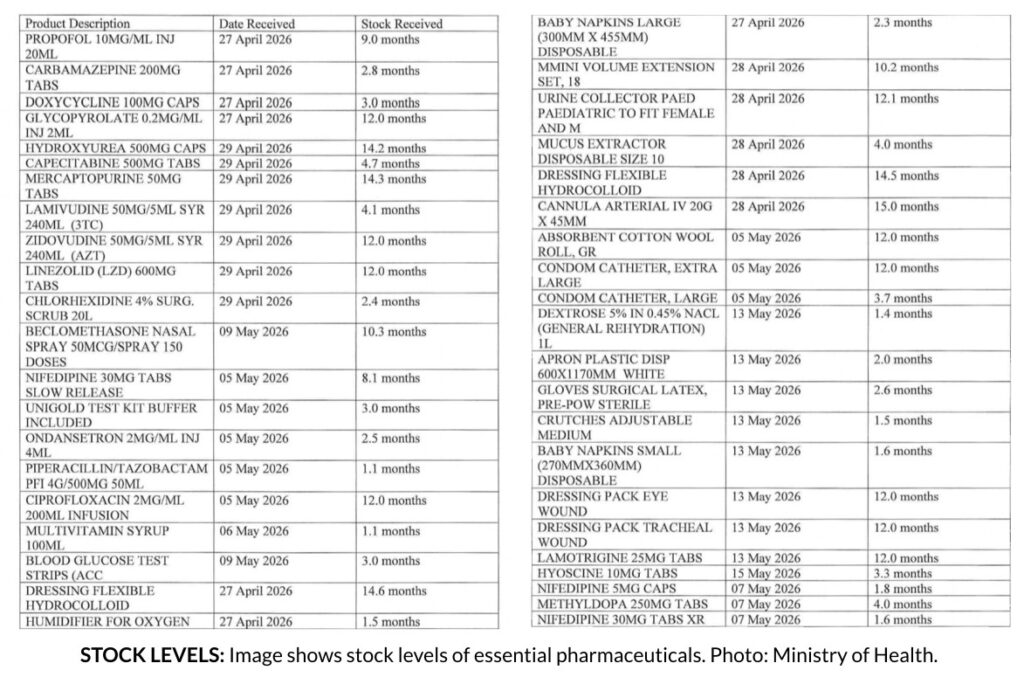
These include less than three months’ stock of Carbamazepine 200mg tablets, used to control certain types of seizures, treat facial nerve pain and manage bipolar disorder. The supplies also include three months’ stock of blood glucose test strips; 1.8 months’ stock of Nifedipine 5mg capsules, primarily used to lower high blood pressure, treat chest pain and manage conditions such as Raynaud’s phenomenon; 1.6 months’ stock of Nifedipine 30mg XR, used for hypertension and chest pain; and four months’ stock of Methyldopa 250mg, used primarily to treat hypertension.
“The quantities reflect additional stock received to strengthen national inventory levels, while addressing current urgent needs. In some cases, the quantities received may appear lower as they are intended to supplement existing stock already available within the supply system. Certain suppliers have further confirmed that deliveries will be completed in batches over the coming weeks, based on production schedules and stock availability. For several key products, the Ministry has already secured and received quantities equivalent to nine months of stock and above, while in other instances limited quantities were procured immediately based on available supplier stock, in order to mitigate urgent shortages pending subsequent deliveries,” the Health ministry said.
The ministry said measures are under way to restore and stabilise pharmaceutical stock levels within the coming weeks. These include the urgent procurement of out-of-stock essential medicines from local, regional and international markets to address immediate shortages.
At the same time, the ministry is pursuing direct procurement arrangements for bulk supplies to ensure the long-term stability of essential medicines and clinical products.
The ministry noted that strategies being implemented include pooled procurement systems to benefit from economies of scale and improve cost efficiency, as well as direct sourcing from manufacturers and partnerships with strategic intermediaries to secure large volumes of readily available stock.
Additional interventions include accelerating the processing of medicine registration documentation and clearance procedures for urgently needed, high-quality pharmaceutical products; expanding supplier and manufacturer networks to diversify procurement channels and reduce reliance on a limited number of suppliers; and strengthening bulk procurement, forecasting systems and real-time stock monitoring to improve planning and maintain sufficient reserve stock levels.
The ministry added that it is also enhancing supply chain monitoring systems to improve oversight of stock levels and enable timely responses to shortages; speeding up procurement processes for essential medicines and critical healthcare commodities; and strengthening collaboration with international, regional and local partners to secure rapid access to urgently needed pharmaceutical products.
Furthermore, the ministry plans to improve inventory management and redistribution systems to ensure medicines are quickly delivered to facilities facing shortages; increase national buffer stock capacity to reduce the risk of future disruptions; and continue engaging manufacturers to establish sustainable long-term supply agreements that will improve the reliability and predictability of medicine availability.
According to the ministry, efforts are also focused on strengthening the operations, staffing capacity, risk management and logistics systems of the Central Medical Stores to improve efficiency in the receipt, storage and distribution of medicines across the country. Institutional reforms and capacity-building measures are also being pursued at the Namibia Medicines Regulatory Council (NMRC) to improve operational efficiency and accelerate application assessments and product registration processes.
“The Ministry acknowledges the frustration and impatience felt by the public, and we truly understand that many are unhappy with the current situation. We would like to assure the public that we are working diligently to repair the procurement system and build a new, more reliable pharmaceutical supply mechanism from the ground up. This is not a one-day activity, but we are committed to getting it right. While full restoration is underway, clear updates will be provided monthly,” the ministry added.
STOCK LEVELS: Image shows stock levels of essential pharmaceuticals. Photo: Ministry of Health.