



Staff Reporter
NAMIBIA has become the only country in Africa with advanced forensic technology to identify timber species, following the handover of specialised equipment by the United States government to help authorities combat illegal timber trafficking.
The equipment for the Wood Identification and Screening Centre was handed over at the Namibian Police Forensic Science Institute in Windhoek by U.S. ambassador John Giordano to Home Affairs Minister Lucia Iipumbu and Namibian Police inspector general Joseph Shikongo.
The technology enables law enforcement officials to scientifically identify timber species from small samples, helping authorities verify shipments, detect protected or illegally harvested wood and provide forensic evidence for criminal prosecutions.

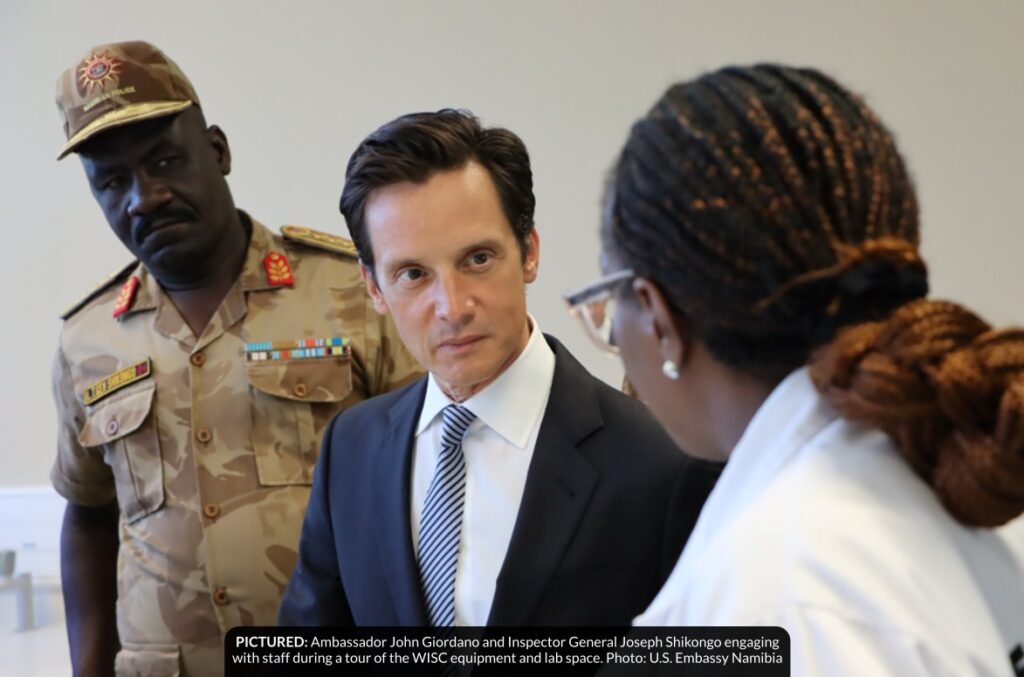
Photos: U.S. Embassy Namibia
The project forms part of a broader United States initiative to strengthen law enforcement cooperation with Namibia in combating wildlife trafficking and other environmental crimes.
According to the U.S. embassy, the equipment represents a commitment of more than US$2 million in technology and training provided through the U.S. Department of State’s Bureau of International Narcotics and Law Enforcement Affairs and implemented by the U.S. Forest Service over the past four years.
The initiative falls under a wider US$8.7 million programme launched in 2020 aimed at improving Namibia’s ability to tackle wildlife and environmental crimes through stronger border security, improved access to criminal data and closer cooperation between law enforcement agencies.
The programme also supported the establishment of the Environmental Crimes Court in Otjiwarongo and strengthened collaboration between Namibian authorities and international law enforcement partners.
Speaking at the ceremony, Giordano said illegal timber trafficking is a multi-billion-dollar transnational crime that deprives countries of natural resources and revenue while undermining the rule of law.
He added that criminal networks involved in the illegal timber trade often use the same routes and methods to traffic narcotics, weapons and people.
“With this equipment, Namibian authorities will be able to verify species claims in shipping containers, detect fraudulent documentation and provide credible evidence in court,” he said.
Giordano added that the technology would help disrupt criminal networks that use Namibia as both a source and transit point for illegally harvested timber.
Officials said Namibian forensic specialists have received training from American experts to operate the system and produce evidence that meets legal standards.
The Wood Identification and Screening Centre will support inspections at ports of entry, including cargo shipments, where authorities can now test timber samples to determine whether the wood matches declared species or originates from protected sources.
The U.S. embassy said the facility will be operated by Namibian specialists and is intended to strengthen the country’s capacity to protect its natural resources while supporting lawful trade.
Giordano said the United States remains committed to supporting Namibia’s efforts to strengthen its legal frameworks and enforcement capacity to combat illegal timber and wildlife trafficking.


