Staff Reporter
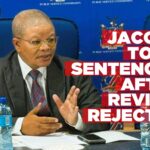
THE Supreme Court of Namibia has declined to invoke its powers to review a matter wherein the Chairperson of the Public Service Commission, and former Chief Regional Officer (CRO) of the //Kharas Region, Salmaan Jacobs, sought to overturn a High Court appeal ruling which resulted in him being found guilty of corruption.
Jacobs is now set to appear in the Keetmanshoop Regional Court on 12 May 2026 for sentencing after the Supreme Court declined to hear his review application.
The High Court in November 2025 set aside a 2014 Keetmanshoop Magistrate’s Court ruling that had cleared Jacobs of corruption, after Prosecutor General Martha Imalwa successfully appealed the case.
Jacobs was subsequently found guilty on one count of corruption by the High Court, after the court found that he used his office for gratification (as former Chief Regional Officer (CRO) of the //Kharas Region) in that he allegedly transferred a total of N$30,000 to a company, Sadidi Enterprises CC, which is owned by himself and his wife, Annamarie Jacobs, in 2006 under the pretense of funding a community gardening project in Berseba.
The State alleged that the N$30,000 that ended up in the account of Sadidi Enterprises CC was supposed to be given to a development committee in Berseba, but this money was never given to them and was instead used by Salmaan Jacobs to settle arrears on a vehicle loan he had.
The High Court, however, dismissed an appeal to overturn an acquittal in terms of a catering tender that had been awarded to Salmaan’s wife for a project in 2006.
In an order, the Supreme Court stated that the request for the court to invoke its review in terms of Section 16 of the Supreme Court Act of 1990 (Act 15 of 1990) is declined. However, no reason had been provided as to why the Supreme Court decided to refuse to invoke its review jurisdiction.
Lawyer Boris Isaack, representing Jacobs, said that the review application, amongst others, sought to challenge the procedures followed by the State in its appeal application, which it won against Jacobs.
The Supreme Court ruling on Jacobs’ case comes at a time when the Public Service Commission faces leadership vacuums, after the approval of four nominees to the Public Service Commission (PSC) was left in limbo after opposition members walked out of the National Assembly last week, resulting in a lack of quorum.
The parliamentary motion had sought parliamentary approval for the appointment and re-appointment of commissioners nominated by the President. The delay in the approval of new commissioners is further exacerbated by the fact that the term of the current commissioners came to an end in February 2026.
The Public Service Commission is an independent body that mainly advises the President and Government on matters related to the public service.
Photo: Public Service Commission