


Staff Reporter
AFRICAN Heads of State and Government have called for urgent and sustainable malaria financing after the 2025 Africa Malaria Progress Report revealed that the continent recorded 270.8 million cases and nearly 600,000 deaths in 2024, accounting for the overwhelming majority of the global burden. The report, presented at the 39th African Union Summit, warns that declining international funding and stalled progress threaten to reverse decades of gains unless domestic and global commitments are strengthened.
The report was delivered by President Advocate Duma Gideon Boko of Botswana in his capacity as Chair of the African Leaders Malaria Alliance. He cautioned that official development assistance for health in Africa has dropped sharply in recent years, while the latest replenishment of the Global Fund to Fight AIDS, Tuberculosis and Malaria fell short of its target, creating what leaders described as a “perfect storm” for malaria control efforts.
According to the findings, progress in reducing malaria incidence and mortality has stagnated since 2015, with only five AU Member States meeting the 2025 targets under the AU Catalytic Framework to End AIDS, TB and Eliminate Malaria in Africa by 2030. The report projects that a 30% reduction in funding could lead to hundreds of millions fewer insecticide-treated nets being distributed, an additional 146 million malaria cases, nearly 400,000 more deaths—most among children under five—and billions of dollars in lost economic output by the end of the decade. In a worst-case scenario, annual cases could surpass 400 million, with deaths exceeding one million.
In response, leaders reaffirmed their commitment to increasing domestic resource mobilisation and developing sustainable national health financing plans. Twelve countries have established End Malaria Councils and Funds, collectively mobilising more than US$186 million through public-private partnerships. Governments are also urging global partners to honour existing pledges and to renew the World Bank Malaria Booster Programme, recalling its success in accelerating progress following its 2005 launch.
President Samia Suluhu Hassan of Tanzania highlighted the importance of African-led research and innovation, pointing to national investments in advanced malaria technologies and scientific institutions working on new approaches to interrupt transmission.
Despite financial pressures, the report notes advances in the deployment of next-generation tools. The majority of insecticide-treated nets distributed in 2025 were dual active-ingredient nets designed to combat resistant mosquitoes. Twenty-four countries have introduced World Health Organisation-approved malaria vaccines for young children, with distribution rising sharply compared to the previous year. Additional innovations include newly prequalified spatial repellents and expanded seasonal malaria chemoprevention programmes.
Leaders also underscored the need to strengthen health sovereignty through local manufacturing, noting that Africa still imports nearly all of its vaccines and most medicines. Efforts are underway in several countries to establish local production of antimalarial treatments, diagnostics and next-generation nets, while the African Medicines Agency continues to harmonise regulatory frameworks to accelerate access to new health commodities.
Dr Michael Adekunle Charles, Chief Executive Officer of the RBM Partnership to End Malaria, said full deployment of existing and emerging tools, backed by adequate funding, could save millions of lives and significantly boost African economies over the next 15 years.
In a joint call to action, African leaders urged Member States to prioritise malaria as a cornerstone of health and economic transformation, protect both domestic and external funding streams, and accelerate implementation of the Catalytic Framework. They further appealed to international partners to align support with national strategies and invest in resilient health systems capable of sustaining long-term progress toward malaria elimination.
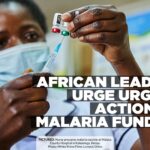
PICTURED: Nurse prepares malaria vaccine at Malava County Hospital in Kakamega, Kenya. Photo: White Rhino Films-Lameck Orina


