Staff Reporter
THE Ministry of Health and Social Services (MoHSS) detected poliovirus Type 2 on 13 November 2025 through routine environmental surveillance from a sewage sample collected in Ndama, Rundu, Kavango East Region.
The detection of the poliovirus in the Kavango East region has ended Namibia’s polio-free status, which had been in place since 2006.
However, Penda Ithindi, Executive Director within the Health Ministry, stated that to date, no polio cases have been reported.

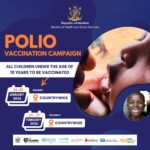
GET VACCINATED: Poster shows dates for polio vaccination campaign. Photo: Ministry of Health.
“Laboratory investigations confirmed that the virus was genetically linked to cases reported in neighbouring Angola, underscoring the ongoing risk of importation and the emergence of vaccine-derived poliovirus. In response to this detection, the Ministry of Health and Social Services, with the support of the World Health Organization (WHO), the United Nations Children’s Fund (UNICEF), and other partners, promptly implemented a targeted regional polio vaccination campaign from 15 to 18 December 2025 in the Kavango East and Kavango West regions,” Ithindi said.
He added that the campaign utilised the Novel Oral Polio Vaccine Type 2 (nOPV2), which is specifically designed to interrupt transmission and prevent outbreaks of poliovirus Type 2.
“Building on the successful implementation of the regional campaign, the MoHSS will now roll out a Nationwide Polio Vaccination Campaign to ensure that all children under the age of 10 years are adequately protected,” Ithindi said.
The national campaign will be conducted in two rounds, scheduled from 26 to 29 January 2026 and 24 to 27 February 2026, respectively.
Vaccination services will be delivered at health facilities, fixed and outreach vaccination points, as well as door-to-door visits by trained vaccination teams.
“Parents and caregivers are strongly encouraged to cooperate with vaccination teams during the door-to-door visits or take their children to designated vaccination points, and to present the child’s health passport where possible. Polio vaccination drops are safe, free of charge, and life-saving. The administration of repeated doses enhances immunity and provides additional protection, even for children who are already fully vaccinated. All children from birth to 10 years of age are required to receive the vaccine in both rounds, including those who were vaccinated during the previous campaign in the Kavango East and Kavango West regions,” Ithindi said.
Poliovirus is primarily transmitted through the faecal-oral route, particularly in areas with inadequate sanitation and hygiene. Although children under five years of age are at the highest risk, all children under 10 years remain vulnerable in communities with suboptimal immunity levels.
Ithindi called upon parents, guardians, caregivers, community leaders, and all partners to actively support the nationwide polio vaccination campaign to ensure that no child is missed.
“Every dose administered is critical to maintaining Namibia’s polio-free status. The nationwide Polio Vaccination Campaign is a preventive public health intervention aimed at protecting children and safeguarding the health security of the nation,” Ithindi said.
For inquiries or clarifications related to this matter, contact Emma Helao, Chief Health Programme Officer, Information Education and Communication Division, Directorate of Primary Health Care, at email: Emma.Helao@mhss.gov.na.