


Staff Reporter
THE Ministry of Health has launched its annual Indoor Residual Spray (IRS) campaign in malaria-endemic regions and is urging citizens to cooperate, as the country has recorded over 93,000 malaria cases since the beginning of the year.
According to the Ministry, a total of 93,598 malaria cases were recorded in the country between January and September 2025 alone. These cases resulted in 136 deaths.
Given the severity of the outbreak, the Ministry is appealing to residents to allow spray teams access to their homes, as IRS remains a key intervention in malaria prevention.
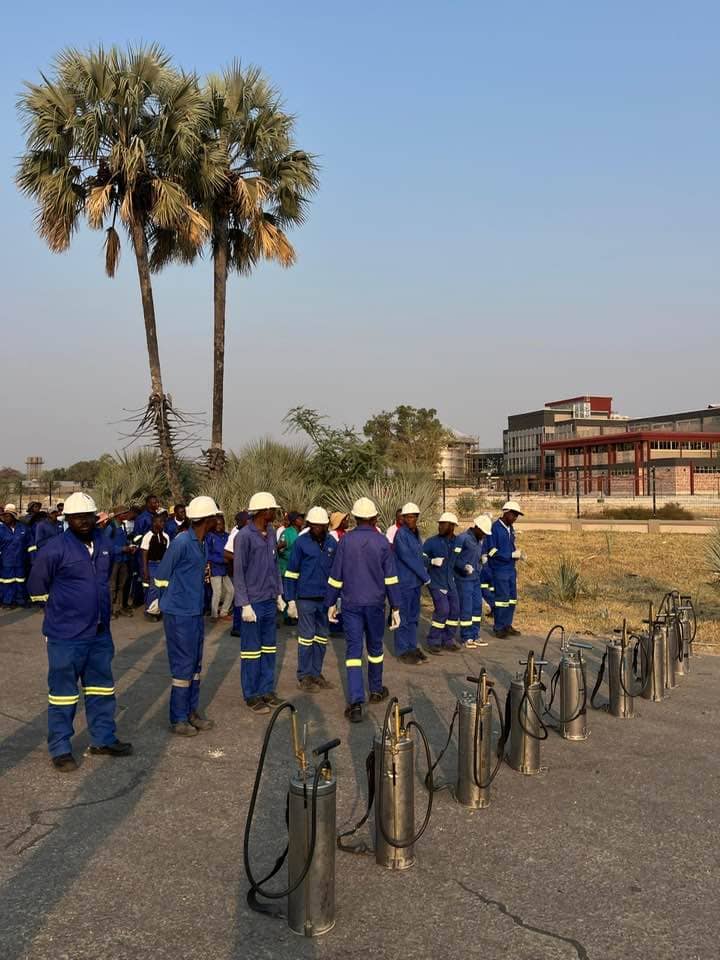
READY TO FIGHT MALARIA: Scenes of ministry staff preparing for the IRS Campaign. Photo: Ministry of Health and Social Services.
The IRS campaign commenced on 22 September 2025 and will conclude on 5 December 2025. It was officially launched in the Kavango West Region, which has been significantly affected by malaria this year, recording a total of 20,964 cases, resulting in 1,520 hospitalisations and 18 deaths since January.
“It is saddening to note that the majority of deaths were children below the age of 15. Nine of the 18 deaths were between the ages of 5 and 14,” the Ministry revealed.
The Ministry added that Kavango West Region’s Nkurenkuru District, in particular, recorded 17,505 malaria cases and 16 deaths, while the Ncamagoro District recorded 3,459 cases and two deaths.
The top villages affected in the Nkurenkuru District are Katwitwi, Nzinze, Karanawa, Matava, Simanya, Musese, Kambumbu, Mpungu and Tuguva. The top villages affected in the Ncamagoro District are Karangana, Halili, Siya, Ntara, Matende, Mupini, Sikondo, Gcamade, Mavanze and Kasivi.
In addition to high infection rates, the Ministry expressed concern over last year’s poor campaign coverage in Kavango West, where community resistance led to an IRS coverage rate of just 52%. Many households either refused spraying or were inaccessible due to locked homes. The Ministry therefore called on the public to cooperate, emphasising the critical role of IRS in preventing malaria.
“IRS involves coating interior walls and other sprayable surfaces in a house with a residual (long-lasting) insecticide. According to the World Health Organization, IRS is one of the primary malaria prevention methods used to target indoor-resting mosquitoes. The mosquitoes usually rest on the walls or other structures of the house after feeding (sucking blood), so when the chemicals are applied to the wall, the mosquitoes absorb them into their systems, which eventually kills them. Hence, IRS usually kills adult mosquitoes after they have fed on blood and rest on a treated surface, which shortens the mosquito’s lifespan and prevents the development and subsequent transmission of malaria parasites to other people. This also renders the parasites causing malaria ineffective and, therefore, reduces malaria infection,” the Ministry explained.
The Ministry revealed that the Kavango West Region achieved only 52% coverage during the previous IRS campaign (September to December 2024), primarily due to spray refusals and locked structures. The top five areas that refused IRS in the Nkurenkuru District were Musese, Siko, Mpungu, Nankudu and Nkurenkuru town. In the Ncamagoro District, the highest refusal rates were recorded in Matende, Halili, Karangana, Mupini and Bunya villages.
Kavango West Governor, Erna Sinimbo, appealed to residents to support the campaign by allowing spray teams access to their homes.
“As your leader, I am hereby urging you to open up your homes and allow the spray operators to spray, in order for us to move together towards malaria reduction and, eventually, elimination,” Sinimbo said.
The Governor also called on spray teams to be respectful and patient when entering homes and encouraged IRS coordinators to share spraying schedules promptly to help communities prepare in advance.


