


Staff Reporter
NAMIBIA has made significant progress by ratifying the International Labour Organisation (ILO) Convention No. 156, which promotes measures that accommodate family needs within employment policies.
This announcement was made by Audrin Mathe, the new Executive Director (ED) of the Ministry of Justice and Labour Relations. He explained that the convention’s objective is to enable the reconciliation of work and family life by encouraging measures that accommodate family needs in employment policies, thereby enhancing protection and support for workers balancing professional and family responsibilities.
“Convention 156, adopted in 1982, applies to men and women workers with responsibilities in relation to their dependent children and their immediate families where such responsibilities restrict their possibilities of preparing for, entering, participating in or advancing in economic activity,” Mathe explained.
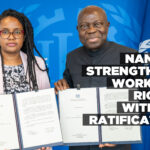
He revealed that the instruments of ratification were deposited by Namibia’s Permanent Representative to Switzerland and the United Nations Office in Geneva, Ambassador Julia Imene-Chanduru, with the ILO Director-General, Gilbert Houngbo, in Geneva on Thursday, 14 August 2025.
Imene-Chanduru emphasised that the ratification of Convention 156 demonstrates Namibia’s strong commitment to building an inclusive society and ensuring equal opportunities for both men and women to participate in the labour market, especially those who care for their families.
Mathe echoed these sentiments, highlighting that the ratification affirms Namibia’s dedication to advancing social justice, promoting gender equality, and enabling family-friendly workplace policies. He added that ratifying the Convention signals the country’s intention to be legally bound by its provisions and to take the necessary legislative or administrative actions to ensure effective implementation, as it becomes domestic law under the Namibian Constitution and is therefore directly enforceable.
“The depositing of the instruments marks a significant step for Namibia in reinforcing the protection of workers with family responsibilities within the country by aligning with international labour standards. The ratification speaks volumes in affirming Namibia’s commitment to advancing social justice, promoting gender equality and enabling family-friendly workplace policies,” Mathe added.


