


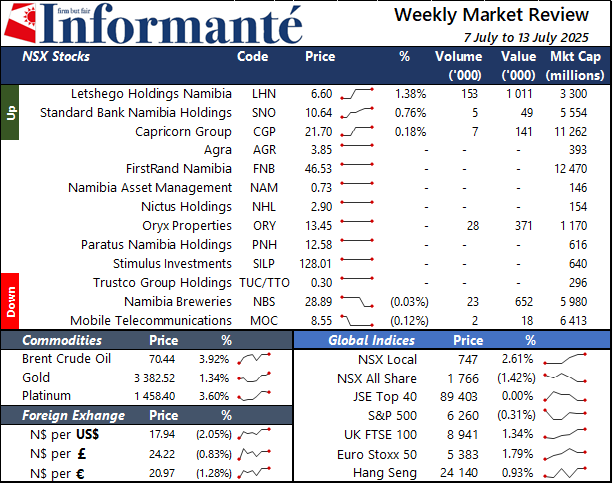
Namibian equity markets delivered sharply contrasting performance this week, with the NSX Local index posting a robust gain of 2.61% to close at 747.1 points, while the broader NSX Overall Index retreated by 1.42% to finish at 1765.9 points. As of July 13, 2025, the market capitalization structure among leading companies shows marginal changes. FirstRand Namibia continues to dominate with a market value of N$12.5 billion, while Capricorn Group has strengthened its second-place position with a slight increase to N$11.3 billion. Mobile Telecommunications maintains its third-place ranking at N$6.4 billion, followed by Namibia Breweries at N$6.0 billion. The financial services sector demonstrated particular strength this week, with Letshego Holdings Namibia emerging as the standout performer. The microfinance group’s shares appreciated by 1.4% to close at N$6.60 per share, continuing its recent positive momentum. Standard Bank Namibia Holdings secured second place among gainers, with its stock advancing 0.8% to settle at N$10.64. Trading activity was led by Letshego Holdings Namibia, which not only delivered strong price performance but also commanded the highest liquidity with N$1.0 million worth of shares changing hands during the period. Namibia Breweries recorded the second-highest trading volume at N$700 thousand. Currency markets proved challenging for the Namibia Dollar, which weakened across all major trading partners. The local currency declined 2.05% against the US Dollar to close at N$17.94. Against the British Pound, the Namibia Dollar fell 0.83% to finish at N$24.22, while declining 1.28% against the Euro to end the week at N$20.97.
Namibia’s inflation trajectory continued its gradual moderation in June 2025, with the headline annual rate declining to 3.7 percent from the 4.6 percent recorded in the corresponding month last year. Monthly price dynamics showed a notable deceleration, with the inflation rate registering zero percent growth on a month-on-month basis, down from the 0.2 percent increase recorded in May. Regional inflation patterns revealed shifting dynamics across the country’s economic zones. Zone 1, encompassing the northern regions of Kavango East, Kavango West, Kunene, Ohangwena, Omusati, Oshana, Oshikoto, Otjozondjupa, and Zambezi, recorded the highest annual inflation at 3.9 percent, marginally exceeding the national average. Zone 3, comprising the //Kharas, Erongo, Hardap, and Omaheke regions, registered inflation precisely in line with the headline rate at 3.7 percent. The capital region, Zone 2 (Khomas), continued to experience the lowest inflation at 3.3 percent. Analysis of inflation drivers shows that essential consumer categories remain the primary sources of price pressure. “Food and Non-Alcoholic Beverages” maintained its position as the largest contributor, adding 1.3 percentage points to the headline inflation rate, reflecting persistent pressures in agricultural and imported food costs. Both “Alcoholic Beverages and Tobacco” and “Housing, Water, Electricity, Gas, and Other Fuels” contributed equally to inflationary pressures, each adding 1.0 percentage point to the overall rate.


