


Zorena Jantze
MAGISTRATE Monica Andjaba today dashed the hopes of the former Minister of Agriculture, Water, Fisheries and Land Reform, Dr McAlbert Hengari (59), and his 30-year-old male co-accused of being released, stating that the court found entrapment is not a recognised defence under Namibian law.
The two were jailed in late April for attempting to pay a bribe to a 21-year-old woman who accused the former minister, Dr Hengari, of rape and face charges of obstructing the course of justice, read with provisions of the Riotous Assemblies Act, as well as corruptly giving gratification as inducement, incitement to commit an offence of compounding, and contravening Section 34 of the ACC Act of 2003.
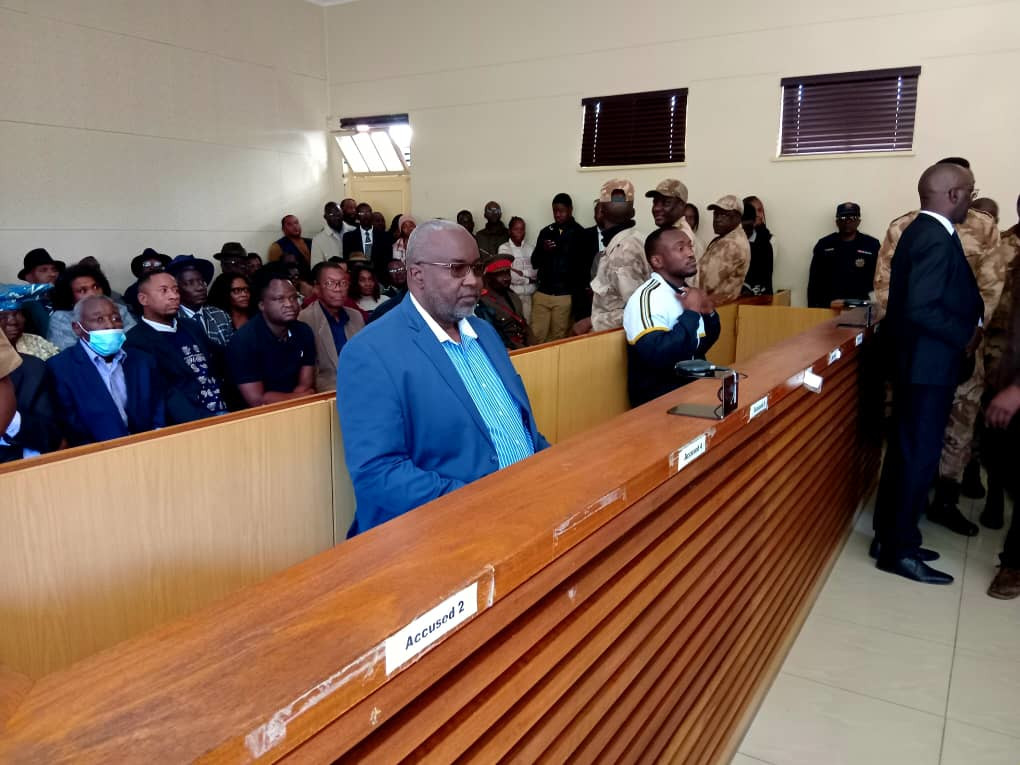
UNSUCCESSFUL: The former Minister of Agriculture, Water, Fisheries and Land Reform, Dr McAlbert Hengari and his co-accused in the dock. Photo: Zorena Jantze.
The lawyers representing the accused—Patrick Kauta for Hengari and Kadhila Amoomo for the second accused—argued that the arrest and detention of Hengari and his co-accused were unlawful due to entrapment, in that the Namibian police conspired with the victim to have Hengari pay her a bribe. Their defence, however, fell flat, as Magistrate Andjaba referenced the case law State vs Nangombe, which detailed that entrapment is not recognised as a defence in Namibian law. She, however, added that if entrapment leads to an unfair trial, it can be a ground for challenging the admissibility of evidence or the prosecution itself.
“Entrapment is not recognised as a defence under Namibian law. However, the case acknowledged that the provisions of Articles 12 and 25 of our Constitution could be relevant if entrapment leads to an unfair trial. The court emphasized the need to assess whether the accused’s constitutional rights were violated. What is gathered by the above case law, when applied to the current matter, is that entrapment alone is not a basis for unlawful arrest and that entrapment is not a defence per se, but the manner in which evidence is obtained can impact the admissibility of evidence and fairness,” Andjaba said.
She added that, as a matter of fact, entrapment ought to be proved on a factual basis, and that it is apparent from the case law that the accused must present evidence or affidavits demonstrating several factors, such as law enforcement having encouraged, persuaded or pressured the accused to commit the offence. She added that it should also be proven that the accused was not already predisposed to commit the offence, or that the conduct of the police did not merely provide an opportunity but rather manufactured an offence.
“What was presented was the affidavit of Detective Inspector Werner; there was nothing further before the court to make an informed decision. It’s a factual issue that requires evidence. The court finds that the application for release based on entrapment is not only premature but unsubstantiated as well. The court finds that the arguments raised—that Werner was the arresting officer, complainant and investigator—is a non-issue for the court to decide, and it is not clear from arguments what the court should do with this information,” Andjaba said.
She added that, in relation to the issue of unlawful arrest, where issue is taken with the lawfulness of an arrest, the burden shifts to the state to prove that the arrest was indeed lawful.
“It is not required, in terms of Section 40 subsection 1 of the Criminal Procedure Act, that an offence was actually committed. The question is whether the arresting officer had reasonable grounds for suspecting that such a crime had been committed. This requires that the arresting officer formed suspicion based on reasonable grounds,” Andjaba said.
She added that the plaintiff, Hengari, and his co-accused admitted that they never applied for bail, and questioned how it can be said that they were detained unlawfully. “There is no direct or inferential evidence that the arrest was arbitrary,” Andjaba said, adding that above all, the accused are fully represented and are not left without remedy, as they have the right to bring a bail application for release.
Andjaba added that the accused’s first appearance was on 28 April 2025, and that the court postponed the matter to 3 June, with a further remand of the accused without objection from the lawyers. “It is the warrant of detention authorised by the court that caused the detention of the accused since 28 April and not their arrest,” Andjaba said.
The lawyer representing Hengari, Patrick Kauta, indicated that they would bring an application on 12 June 2025, in which they would aim to quash charges, requesting that the court nullify the charges against the accused as they are not only allegedly unlawful but also unconstitutional.


