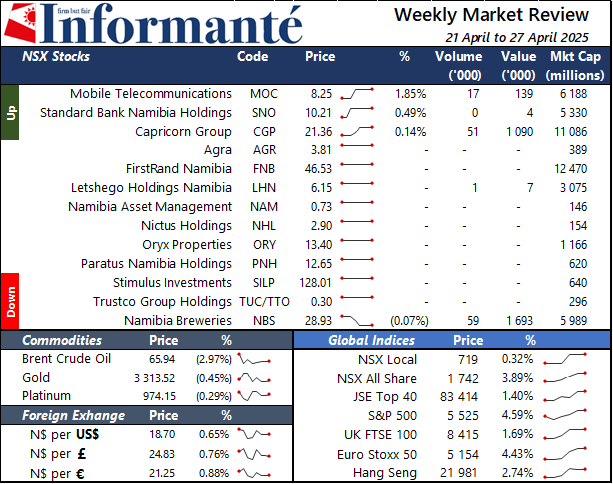
The Namibian Stock Exchange demonstrated continued strength this week as both major indices posted gains, with the NSX Local index advancing 0.32% to close at 719.1 points, while the NSX Overall Index registered a more substantial increase of 3.89%, finishing at 1742.3 points. As of April 27, 2025, FirstRand Namibia maintained its position as the exchange’s dominant player with a market capitalization of N$12.5 billion, followed by Capricorn Group at N$11.1 billion. Mobile Telecommunications solidified its third-place standing with an increased valuation of N$6.2 billion, maintaining its edge over Namibia Breweries, which held steady at N$6.0 billion. Mobile Telecommunications emerged as the week’s standout performer, gaining 1.9% to close at N$8.25 per share. Standard Bank Namibia Holdings followed with a modest increase of 0.5%, ending at N$10.21 per share. Namibia Breweries leads volume statistics at N$1.7 million worth of shares traded. Capricorn Group secured the second position with N$1.1 million in trading volume. On the currency front, the Namibian dollar strengthened consistently against all major foreign currencies. The local currency appreciated 0.65% against the US dollar to close at N$18.70, gained 0.76% against the British pound to end at N$24.83, and recorded its strongest performance against the euro with a 0.88% gain, closing at N$21.25.
The International Monetary Fund has significantly downgraded its global growth projections in its April 2025 World Economic Outlook, with worldwide expansion now expected to slow to just 2.8 percent in 2025 and 3.0 percent in 2026—marking a substantial 0.8 percentage point reduction from January forecasts. This dramatic revision stems primarily from an unprecedented escalation in trade tensions, with the United States implementing near-universal tariffs on April 2 and trading partners responding with countermeasures, pushing effective tariff rates to century-high levels. The resulting policy uncertainty has created what analysts describe as a “major negative shock” to global economic momentum, with growth projections now falling well below the 2000-2019 historical average of 3.7 percent. Advanced economies face particularly challenging conditions, with growth expected to reach just 1.4 percent in 2025. The United States, at the center of the trade disputes, is projected to slow dramatically to 1.8 percent—a 0.9 percentage point reduction from January estimates—as policy uncertainty, trade frictions, and weakening demand take their toll. Meanwhile, the euro area faces its own struggles with growth projections revised downward by 0.2 percentage points to a sluggish 0.8 percent, reflecting the region’s vulnerability to global trade disruptions. Emerging market and developing economies, while still outperforming their advanced counterparts, are not immune to the global slowdown, with growth expected to moderate to 3.7 percent in 2025 and 3.9 percent in 2026. Countries most exposed to recent trade measures, particularly China with its projected 4.0 percent growth rate for 2025, have experienced significant downward revisions. Inflation projections have also been adjusted, with global headline inflation now expected to decline more gradually than previously anticipated, reaching 4.3 percent in 2025 and 3.6 percent in 2026. Sub-Saharan Africa stands as a relative bright spot amid the global economic turbulence, with the region projected to grow by 3.8 percent in 2025 and accelerate to 4.2 percent in 2026. Nigeria and South Africa, the region’s largest economies, show divergent paths with Nigeria expected to maintain robust growth at 3.0 percent in 2025 before moderating to 2.7 percent in 2026, while South Africa’s more modest recovery continues with 1.0 percent growth in 2025 strengthening to 1.3 percent in 2026. The region’s overall resilience against global headwinds suggests potential for continued economic development despite the challenging international environment.