



Staff Reporter
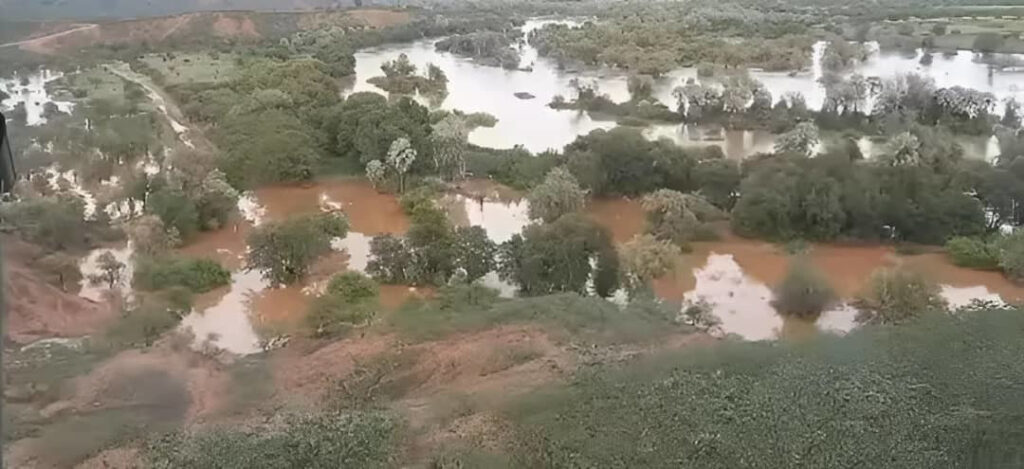
The heavy showers that began last week in many parts of the country have revitalised various rivers across the country.
This includes the western-flowing ephemeral rivers in the interior, which flooded last week following heavy rains in the catchment areas of the Hoarusib, Hoanib, Ugab, Uniab, Koigab, Huab, Kuiseb, Omaruru, Tsauchab, and Swakop Rivers. In the south, the Fish River and Oanib River also flooded last week.
The Zambezi River has also experienced a rise in its water levels over the past week. According to Namibia’s Hydrology Services, the Zambezi River at Katima Mulilo recorded a water level of 3.88 metres (m) last Tuesday, 18 March 2025. By this Tuesday, 25 March 2025, the river had risen to 4.41m – more than triple the 1.33m recorded at the same time last year.
The Hydrology Services also reported that the Okavango River’s water level at Rundu increased from 5.74m on Monday to 5.79m on Tuesday. This is higher than the 5.34m recorded at the same time last year.
The Kunene River also saw a major change in the last week. According to the Hydrology Services of Namibia, the Kunene River recorded a flow of 711.30 cubic metres per second (m³/s) on Tuesday, 25 March 2025 – a sharp increase from 299.10 m³/s recorded the previous week, on Tuesday, 18 March 2025. This is also double the 355.30 m³/s measured on the same date last year.
Given the recent stormy conditions and their impact, Hydrology Services has advised the public to exercise extreme caution, including avoiding crossing flooded or fast-flowing waters. They have also recommended activating multi-hazard contingency plans for flood risk mitigation and recovery in flood-prone areas.
The Hydrology Services further urged operators of major dams to activate their dam flood management plans, as the country’s total dam content already stood at 75.7% on Monday, 24 March 2025.


