


Staff Reporter
MOST of the country’s dams saw little to no inflow in the 2023–2024 financial year (FY23/24) compared to the previous financial year.
This is highlighted in NamWater’s latest Integrated Annual Report, which shows that water levels in most dams during FY23/24 were lower than those recorded in FY22/23. Notably, the Omatjene, Nauuaspoort, and Omdel dams remained empty throughout FY23/24. However, NamWater pointed out that there were some exceptions as some dams experienced an increase in water levels compared to the previous year.
The exceptions include the Otjivero Silt Dam, which recorded 0.102 mm³ in FY23/24, up from 0.050 mm³ in FY22/23; the Dreihuk Dam, which saw a rise from 0.221 mm³ in FY22/23 to 2.979 mm³ in FY23/24; Bondels Dam, which went from empty in FY22/23 to 1.134 mm³ in FY23/24; Olushandja Dam, which recorded 16.558 mm³ in FY23/24 compared to 8.479 mm³ the year before; and the Calueque Dam, with 501.58 mm³ in FY23/24, up from 193.424 mm³ in FY22/23.
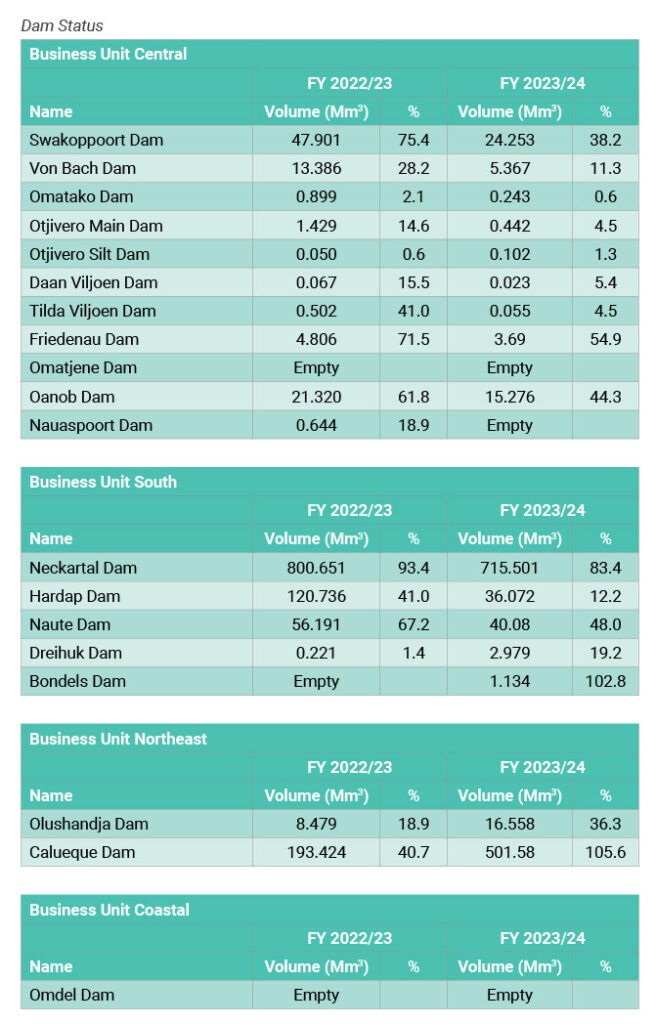
Despite these exceptions, NamWater’s report makes clear that most dams received significantly less inflow in FY23/24 compared to the previous year.
“This implies that the available water will not be enough (in most of the dams) to breach the two rainy seasons operational policy. For the central part of the country, the water supply will be augmented from the groundwater sources; however, the available water will not be sufficient to breach the two rainy seasons operational policy, and thus, water demand management must be implemented,” NamWater explained.
Regarding river conditions, NamWater reported that during the 2023/24 hydrological season, the Kunene River at Ruacana peaked at 739.06 m³/s in January 2024, which was lower than the previous rainy season. The Kavango River at Rundu reached a peak water level of 6.02 m in January 2024, nearly identical to the previous season. Additionally, the Zambezi River at Katima Mulilo peaked at 1.71 m in February 2024, which was lower than the previous year.
For the Orange River, NamWater revealed that the water level peaked at 3.90 m at Noordoewer, while the Rosh Pinah peak was 3.79 m, both lower than in the previous year.
NamWater also emphasised the importance of two critical groundwater systems under its management: the Karst aquifer in the north-central part of the country and the alluvial aquifers along the west coast, which supply coastal towns.
“The status and sustainability of these systems are essential to NamWater’s mandate and the economic sustenance of the industries and the country at large. The north-central aquifers tend to perform better than the coastal aquifer system due to differences in the amounts and frequency of replenishment, which are tied to the rainfall in those two regions,” NamWater explained.
According to NamWater, the north-central aquifer system can be regarded as full compared to the time of its establishment. In contrast, the coastal aquifer system ranges between 44% (Omdel) and 79% (Kuiseb) relative to initial conditions.
“In terms of the reserve, all major aquifers were observed to have reduced in volume due to a poor rainfall season, signifying low recharge. Major groundwater sources indicate that about 431 Mm³ of good-quality groundwater will be available to NamWater for 5 to 15 years,” NamWater added.


