


Business Reporter
THE EU Delegation to Namibia today hosted a stakeholder workshop focused on EU-Namibia trade and investment relations. The event served as a platform to discuss the draft key findings from an independent study on the EU – Namibian trade data and foreign direct investment (FDI).
It was revealed that the European Union (EU) was Namibia’s top source of foreign direct investment (FDI) in 2023, contributing N$12.7 billion to the country’s economy, coming in third place after China and South Africa with an injection of N$70 billion and N$36 billion respectively.
The study was conducted by Robin Sherbourne, a highly regarded independent economist and long-time observer of Namibia’s economic landscape, known for authoring the Guide to the Namibian Economy published by the Institute for Public Policy and Research.
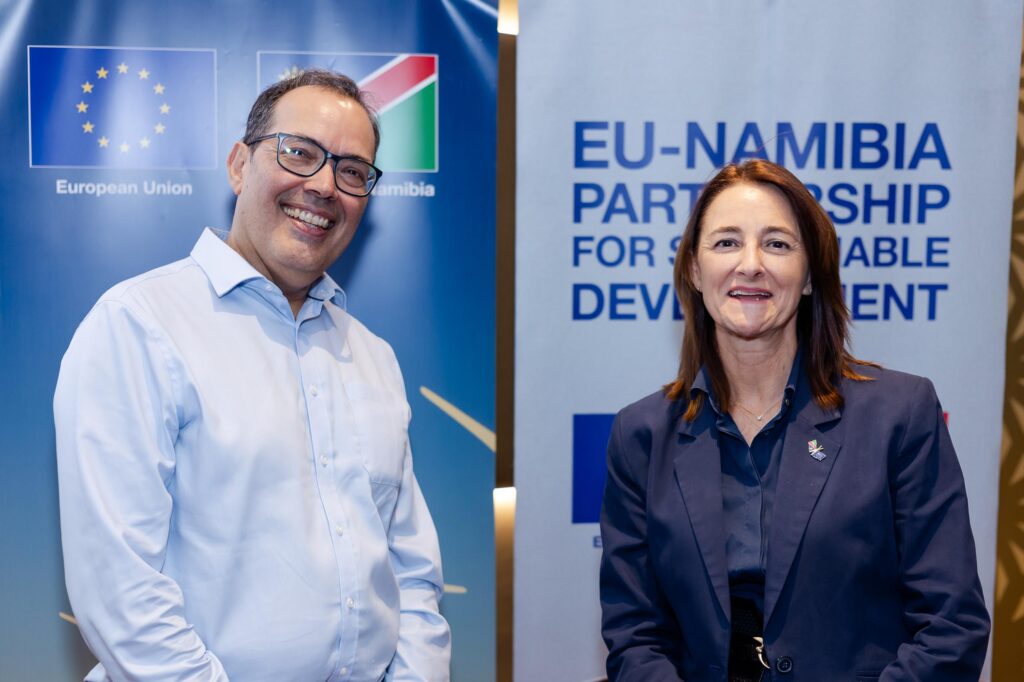
EU Ambassador to Namibia, H.E. Ana Beatriz Martins, remarked that the purpose of commissioning this study and sharing its findings was to gain a more precise understanding of trade and investment flows between Namibia and the European Union over the past decade.
“This will help us better understand the evolution of Namibia’s exports to Europe, trends by destination, sectors and investments,” she said.
Ambassador Martins further highlighted that such data strengthens policy analysis, identifies growth opportunities, and supports economic planning. She added, “It can also underpin more efficient resource allocation, for instance, identifying where investment in infrastructure, such as ports and logistics, is most needed. This is particularly important within the context of the Economic Partnership Agreement (EPA) and the strategic Partnership on Raw Materials Value Chains and Renewable Hydrogen between the EU and Namibia.”
In his presentation, Sherbourne outlined several key insights from the study. Among them, he noted that the EU has consistently been one of Namibia’s most important trading partners, emerging as the country’s largest export market in recent years. “Namibia also enjoys a trade surplus with the EU, exporting more than it imports,” Mr Sherbourne explained.
The study emphasised that the EU operates as a single trading bloc, a fact critical to any analysis of Namibia’s trade patterns and that Namibia’s exports are concentrated in a few foreign markets, with the EU, South Africa, Botswana, and China ranking as the most significant in terms of value.
In addition to this, Namibia’s diamond, uranium, and gold exports largely shape its overall trade pattern. In 2023, 95% of Namibian exports to the EU were destined for Belgium, Spain, the Netherlands, France, Italy, Germany, and Portugal.
The EU imports a diverse range of Namibian products, including refined copper, diamonds, uranium, hake, table grapes, charcoal, marble, and leather hides.
Namibia has increasingly diversified its sources of imports beyond South Africa to include the EU, China, India, and the UAE.
The EU has been a vital source of imports for Namibia since at least 2004, ranking second after South Africa in recent years. In 2023, Germany, the Netherlands, Italy, Spain, France, Poland, Greece, and Ireland accounted for 75% of imports from the EU.
Sherbourne also noted that EU-based companies have been active investors in Namibia across various sectors, including agriculture, fishing, mining, oil and gas, manufacturing, green hydrogen, renewable energy, and hospitality. While this reflects a robust investment relationship, further analysis is required to draw more detailed conclusions about FDI trends.
He concluded that the draft findings of this study underscore the importance of the EU-Namibia partnership in fostering sustainable economic growth and exploring new opportunities for trade and investment.


