Staff Reporter
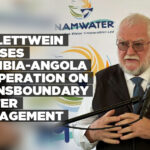
THE Minister of Agriculture, Water and Land Reform, Calle Schlettwein, has highlighted Namibia and Angola’s cooperation on transboundary water management as a prime example of effective collaboration.
“These collaborative efforts, supported by data-sharing systems, have been instrumental in addressing water scarcity, strengthening climate resilience, and ensuring fair water resource allocation, as this is the only basin with an established volumetric allocation,” Schlettwein said.
He made these remarks at the high-level special session, “Our Waters, Our Future: Transboundary Water Cooperation to Power Climate Resilience,” in Slovenia, where he expressed pride in Namibia and Angola’s collaborative efforts in water management.
“Key initiatives include flood management in the Cuvelai-Etosha Basin, sustainable water use and environmental conservation efforts along the Okavango River, and the management of the Kunene River through the Calueque Dam and Ruacana Hydropower Station,” the minister pointed out.
Schlettwein stressed that Namibia is committed to promoting sustainable development and securing fair access to water resources, especially as the country shares water resources with other nations.
He expressed hope that communication and collaboration in managing the Orange-Senqu River, which Namibia shares with countries such as Lesotho and South Africa, would also continue, particularly given the impacts of drought in Namibia and the river’s current low flow levels.
Schlettwein noted that the Orange and Kunene rivers, which Namibia shares with other countries, have at times run dry. This, he said, is not only due to drought but also over-utilisation upstream, resulting in Namibia, as a downstream country, suffering the consequences. The minister said this situation is unsustainable, unfair, and indefensible, emphasising the need for a Water Convention to ensure the sustainable management of shared water resources in southern Africa.
“By acceding to the Water Convention, Namibia aims to unlock new opportunities for enhanced rule-based cooperation in sub-Saharan Africa. This framework, which has already benefited European and some African countries, promotes conflict prevention and regional stability. We firmly believe that the Water Convention is one of the key international instruments that supports the sustainable management of shared water resources, contributes to the achievement of the Sustainable Development Goals (SDGs), and fosters peace, security, and regional integration,” he explained.
Schlettwein acknowledged the challenges in negotiating water rights but assured that Namibia’s aim has always been to secure an equitable share of these essential resources.
“This cooperation ensures the sustainable use of water for life and livelihoods, specifically agriculture and food production, urban and rural water supply and sanitation, economic development, and ecosystem conservation. As a member of the shared river basin community, Namibia’s aim has always been to foster collaboration, support sustainable development, and secure an equitable share of these essential water resources. However, negotiating water rights can sometimes be difficult, especially when done in the absence of goodwill and under the influence of water scarcity and competition,” he added.