Staff Reporter
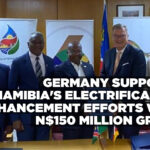
THE National Planning Commission, the Ministry of Mines and Energy (MME), and the Northern Regional Electricity Distributor (Nored) have signed a grant agreement worth approximately N$150 million with the German Development Bank (KfW) to increase access to electricity for households and Small and Medium Enterprises (SMEs) in Namibia.
This project, which aims to improve energy access for 18,000 to 20,000 people, is expected to be completed by 2026.
“The funds complement MME’s own budget allocation for the electrification of Namibia and have been earmarked for peri-urban on-grid and rural remote off-grid electrification, mainly in the north-east and north-west regions of Namibia. According to the latest statistics, the overall rural electrification rate stands at 20% to 30%, while overall electrification stands at roughly 55% nationwide,” the German Embassy explained.

The embassy highlighted that the grant will cover the investment costs to ensure the long-term sustainability and economic viability of the new connections for the regional electricity distributor.
“At the same time, by agreeing on a mixture of peri-urban on-grid and remote off-grid electrification connections, the new lines will generate enough income to ensure regular maintenance by the regional electricity distributor for this operational area, while maximising the developmental impact,” the German Embassy added.
Obeth Kandjoze, the Director General of the National Planning Commission, pointed out that data from the recent census indicates that Namibia, with a population of over 3 million people, might have an electrification rate lower than 55%, particularly in rural areas.
“Hence, the access-to-energy project is a much-needed initiative with substantial impact, and more projects of this kind will augment the government’s efforts to increase access to energy,” Kandjoze added.
The Ministry of Mines and Energy’s Executive Director, Penda Ithindi, emphasised that the N$150 million grant complements the ministry’s budget and electrification plans, highlighting that nearly 4,000 connections will be installed.
“According to the Access-to-Energy Project plan, close to 4,000 connections will be installed, which translates to the provision of energy access for 18,000 to 20,000 people, as well as productive users,” Ithindi said.
Nored’s Acting Chief Executive Officer (CEO), Toivo Shovaleka, announced that the project will kick off next week by working on tender documentation.
“The project design foresees that NORED is responsible for overall project implementation and will partly engage service providers for the roll-out. With regards to off-grid solutions, the funding proposal is intended to strengthen respective operating providers in their growth,” the German Embassy explained.
The embassy added that the success of the grant programme will be measured against indicators, one of which is the installation of at least 2,910 new on-grid connections (minimum TIER 4) and 990 new off-grid connections (minimum TIER 3). The embassy also highlighted the installation of 400 kW off-grid power capacities for mini-grids based on solar PV plus storage as another progress indicator.
“The Access-to-Energy Project will fight energy poverty by expanding and improving electrification in rural and peri-urban areas, and thus initiate the productive use of electricity, which will expand income opportunities and enhance economic development,” the German Ambassador, Dr Thorsten Hutter, said.