


Staff Reporter
THE World Health Organization (WHO) has recognised Namibia as the first ‘high burden’ country globally to achieve a significant milestone in eliminating mother-to-child transmission (MTCT) of the Hepatitis B Virus (HBV), along with the country’s efforts in addressing MTCT of HIV.
Namibia’s progress in combating MTCT of HBV has merited it a Silver Tier certification from WHO, while progress in fighting MTCT of HIV garnered a Bronze Tier distinction for both 2020 and 2021. These certifications follow an evaluation conducted by the WHO Global Validation Advisory Committee in 2023.
“We are indeed encouraged by the fact that Namibia is the first country in the world to be assessed and recognized to be on the Path-to-Elimination of Mother-to-Child Transmission of the Hepatitis B Virus and also that we are the second country in Africa to be recognized to be on the path to the elimination of Mother-to-Child Transmission of HIV/AIDS, following in the footsteps of our neighbour, the Republic of Botswana,” Prime Minister Saara Kuugongelwa-Amadhila said at the recent award ceremony.
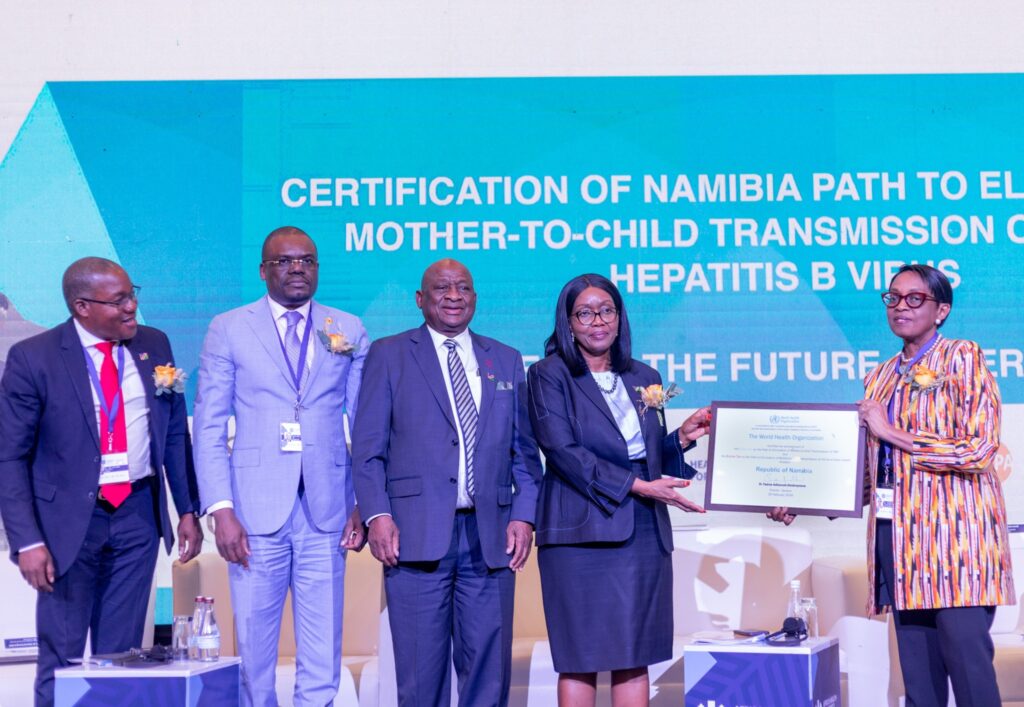
She attributed Namibia’s progress in eliminating MTCT of HBV and HIV to a comprehensive healthcare approach that prioritises prevention, testing, treatment, and support services for mothers and their new-borns.
“It is the result of investing in laboratory services. It is the result of prioritising education, awareness, and community engagement to break down stigma and discrimination as well as respecting human rights. It is the result of efforts towards building robust monitoring and evaluation systems. And it is the result of forging partnerships and collaborations with development and implementing partners, who have been invaluable allies in our shared mission,” Kuugongelwa-Amadhila added.
Her sentiments were further highlighted by the Minister of Health and Social Services, Dr Kalumbi Shangula, who pointed out that Namibia has been implementing the Prevention of Mother-to-Child Transmission (PMTCT) of HIV Programme since 2002. This programme, he explained, is integrated into Maternal and Child Health services, including Antenatal Care (ANC), labour/delivery, and Postnatal Care (PNC), all fully supported by government funding.
Shangula further highlighted the country’s remarkable progress, with 98.5% of infants born to HIV-positive mothers in Namibia being HIV-free in 2023. He reiterated the PMTCT program’s objective to reduce MTCT of HIV, aiming for a rate of less than 2% by 2028.
“We are encouraged that Namibia’s investment in health, particularly in the prevention of mother-to-child transmission of infectious diseases such as HIV and Hepatitis B is paying off, is bearing fruit. These achievements came after many years of investments to offer free services and deliberate, yet consistent actions in the PMTCT programme,” he said.
Shangula emphasized that for a country burdened with high HIV and HBV rates, being recognized on the path to eliminating MTCT of HBV and HIV is a significant achievement.


