


Political Desk
TWO of Namibia’s revered elderly statesmen and who are part of the few surviving members of the Constitutional Committee of 21 members, Dr. Ben Amadhila (Swapo) and Andrew Matjila (DTA), in a historic exclusive interview with Zorena Jantze of Informante and Joep Nel of Trustco Media, revealed behind closed doors the birth of the National Anthem for the first time.
Both legendary politicians are retired from active politics but religiously attend the Constitutional Day function on 9 February to commemorate national unity and the role the 80-day Constitutional writing process under the Chairmanship of Namibian President, Dr. Hage Geingob, played in establishing trust between arch-political rivals. Matjila and Dr. Amadhila still occupy themselves in philanthropy, nation-building, and reconciliation initiatives.
In what can be regarded as one of the first acts of national interest above party politics, Matjila was elected Chairman of the most important portfolio of the National Symbols Committee in the early 1990s, supervising the committee with members such as Dr. Amadhila, the legendary Swapo crown prince, the late Hidipo Hamutenya, and the conservative and sometimes stubborn stalwart of Aksie Christelik Nasionaal (CAN) that, under Monitor Aksiegroep (MAG), later lost its parliamentary representation. A fate that would also befall the Federal Convention of Namibia of Kaptein Hans Diergaardt and Moses Katjiuongua of the first the NPF in co-leadership with Adv. Eben van Zijl, and later the Democratic Coalition of Namibia (DCN).
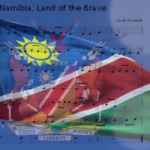
Dr. Ben Amadhila and Andrew Matjila, who took part in the writing of the Namibian constitution, sat on the national symbols committee in the early 1990s that oversaw the creation of the Namibian national flag and anthem that later was only referred to as “Land of the Brave.”
They dusted off their notes in a journey down memory lane to set the record straight after the anthem and the revered Axali Doeseb were unexpectedly dragged into tribalist- and party-political opportunism on social media platforms that found its way into traditional media and raised suspicion on the origin of what was always accepted as a “controversial,” but “collaborative” effort at Namibia’s infancy.
Dr. Amadhila, one of the founding members of the Swapo party and former minister and member of the cabinet, recalled his heydays and said that he was a member of a committee under the leadership of Matjila (DTA) that was created to get Namibia’s national symbols.
“For the national anthem, we invited a number of people to compose and draft the national anthem. There were three or two people who expressed interest. But we settled for Axali Doeseb. He was given the task of putting together those musical notes that constitute our national anthem today. There was input by people who knew melodies and music to have the music rhyme,” Dr. Amadhila said.
He added that the late Hidipo Hamutenya was given the task of crafting the words of the wording of the National anthem, which Hamutenya tabled in the committee for approval.
“There were interventions here and there to change wording. Yes, the wording was done by Hidipo Hamutenya, but it was finally adopted by the committee. There is no question as to who wrote the national anthem. Everyone accepted that it was the late Axali Doëseb, who was the one who wrote and who composed the national anthem, although the wording was a joint venture of the committee, under the leadership of the late Hamutenya,” Dr. Amadhila said.
He revealed that apart from a diplomatic passport, Doeseb was given money for composing the song at the cabinet level.
“A little bit later, it was felt that something be given for his work. We gave him a sum of money, at cabinet level. It was done after independence was attained. If my recollection serves me well, he received N$ 20 000.” In those days, it was a handsome amount of money. All of us were proud. There was a number of renowned people who attempted to do the same, but Axali came out with a piece of music accepted by everyone and by the nation. I do not see what the “controversy” is about. Axali did a great job, and each and every one ought to be proud,” Dr. Amadhila said.
It was also revealed in parliament that an additional N$2 million was allocated to Doeseb before his death.
Adding his take on the matter, the 91-year-old Matjila, upon a call from Informante, was quick to say that “he would not like to throw the cat among the pigeons” however agreed to share his knowledge on the matter after numerous debates have suggested that the late Axali Doeseb did not write the national anthem.
The 91-year-old Matjila, who was a member of the Democratic Turnhalle Alliance (DTA) and who took part in the Transitional Government of National Unity from 1985 to 1989, recalled the past with great clarity. Touching on the crafting of the national anthem, Matjila said that the argument on who wrote the national anthem should have started in 1991. He added that the late Hidipo Hamutenya and Kosie Pretorius, and surviving Dr. Amadhila were some of the politicians who were on the committee that oversaw the crafting of the national song.
“In the event of the national anthem, as far as I’m concerned, I realized that Hidipo Hamuntenya was working with the composer, the Late Axali Doëseb on the song. They had been dealing with the issue together for quite some time, I could see. Axali had the melody, and Hidipo came in with the wording. He wanted to show that they had fought a battle and they had won. He supplied Axali with this wording. They should have argued about who wrote the national anthem in 1991. In 1991 is when they should have said, ‘no, this anthem addresses only one side, and that is Swapo the party. It spoke of those who carried guns on their shoulders and fought. What about the people there outside who did not participate? The song must bring them all together; we are fighting for unity here,” Matjila said.
He added that those who went into exile were labelled as champions while those who stayed behind during apartheid were labelled as white collaborators and puppets.
Ironically the Nobel Peace Prize winner and Special Representative of the UN, Martti Ahtisaari, was buried on the same weekend as the legendary Axali Doeseb and was incidentally a neighbor of Matjila, while another legend of Namibian politics also stayed across the street from Matjila in Pasteur street that became well-known for political residents such as the DTA Chairman, Dirk Mudge, who once owned the house that Matjila now occupies.


