


Business Reporter
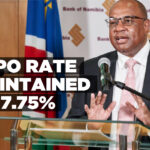
THE Bank of Namibia’s (BoN) Monetary Policy Committee (MPC) has decided to keep the Repo rate unchanged at 7.75%, curbing the rise of interest rates for home mortgage payers and other Namibians who have been feeling the brunt of inflationary effects. Johannes Gawaxab, governor of the central bank, explained that most monitored central banks kept their policy rates unchanged at their most recent monetary policy meetings, including the South African Reserve Bank.
“Generally, central banks across the globe expect interest rates to remain higher for longer, and they remain committed to bringing inflation within target levels in the period ahead,” !Gawaxab said. He added that as of 30th September 2023, the stock of international reserves edged lower at N$53.8 billion, compared to N$55.6 billion recorded at the end of August 2023 and the N$54.2 billion reported at the previous MPC meeting.

“Overall, despite the interest rate differential between South Africa and Namibia, capital flows have remained orderly with no notable speculative behaviour, with the decline in the official reserves predominantly due to net commercial bank outflows and foreign payments by the Government. At this level, the stock of international reserves is estimated to cover 5.6 months of imports, thereby remaining sufficient to support the currency peg between the Namibian Dollar and the South African Rand and meet the country’s international financial obligations,” the central bank governor explained.
He shared that against this background, the MPC decided to keep the Repo rate unchanged at 7.75%. “Accordingly, the prime lending rate remains steady at 11.50%. This policy stance will continue to safeguard the one-to-one link between the Namibian Dollar and the South African Rand, while supporting domestic economic activity, particularly the overstretched households and businesses,” !Gawaxab said. He further noted that recently released quarterly national accounts data indicate that the Namibian economy grew by 3.7% during the second quarter of 2023.
“While still firm, it remains lower compared to the 5.3% observed during the first quarter of 2023 and 8.5% in the corresponding period of 2022. The slowdown in economic growth was mainly due to contractions in sectors such as agriculture and forestry, construction, financial services, as well as public administration and defence,” !Gawaxab said. He added that risks to the domestic economic outlook have intensified since the previous MPC meeting, mainly driven by external factors.
“The external factors include weakening global economic activity, tighter global monetary policy, geoeconomic fragmentation, and continued geopolitical tensions, including the recent Israel-Gaza conflict. Risks associated with the supply of electricity in South Africa seem to have recently softened, although challenges continue to persist. Internal risks include the current drought, uncertain rainfall conditions, and water supply interruptions, particularly in coastal towns,” the governor said.
He also added that since the previous MPC meeting, the annual growth in Private Sector Credit Extension (PSCE) slowed further to 2.3% in August 2023, from 3.0% in June 2023. The slowdown in PSCE growth was attributed to lower demand and net repayments by the corporate sector, especially in the categories of mortgages and other loans, advances, and overdrafts.


