Staff Reporter
THE Deputy Prime Minister and the Minister of International Relations and Cooperation, Netumbo Nandi-Ndatiwah, has warned that malaria is regaining its foothold in the Southern African Development Community (SADC) region, with higher transmission driven by new mosquitoes coming to the region as well as unstable weather caused by climate change.
Nandi-Ndatiwah made these remarks at the High-Level Meeting of SADC E8 Ministers of Health & Ministers of Finance and Key Stakeholders, to re-energize the fight towards malaria elimination.
The purpose of the high-level Indaba is to bring together Ministers of Health and Ministers of Finance from the E8 Member States and their malaria elimination partners to reassess and rededicate themselves to a sustained fight for malaria elimination from the region, through high-level policy and strategic dialogue, with a steadfast focus on dwindling or plateauing resources for sustained elimination efforts.
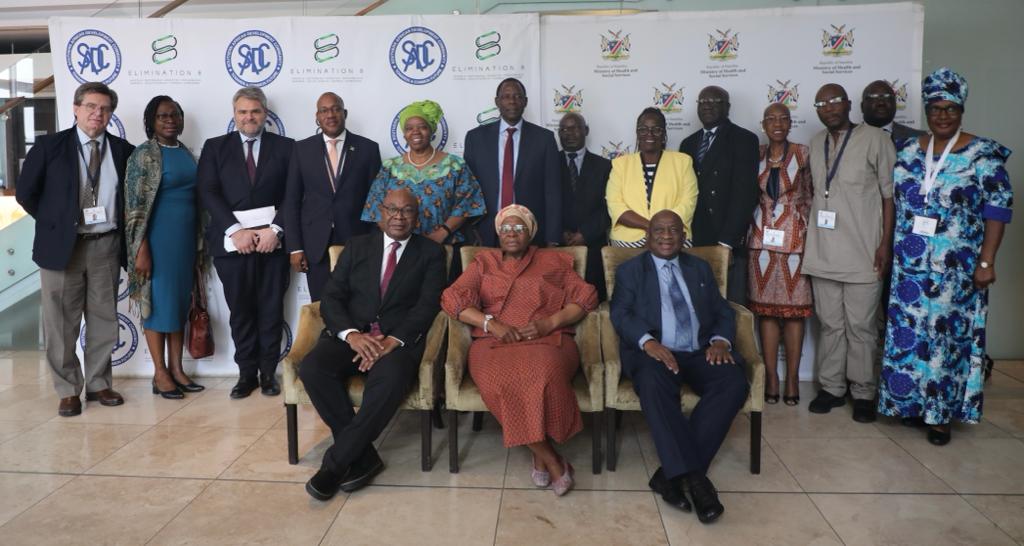
As the host of the subsidiarity institution – SADC Malaria Elimination 8 (E8), Nandi-Ndatiwah said that malaria is one of the old diseases that continues to exert excessive pressure on SADC’s systems and continues to kill its people more than all other diseases.
“The good news is, malaria is preventable and treatable. Equally important, the tools with which to prevent and manage it are available. That is why this disease has been eliminated in some places. I understand that here in Southern Africa, at one point, we were on the verge of eliminating it. Sadly, it is regaining its foothold and reaching areas and populations that were free from it at one point. It is also noted that new mosquitoes are coming into our region, which we do not know how to fight effectively. The chemicals and medicines used on it are losing their efficacy in certain situations. The cost of keeping down malaria is becoming simply unsustainable. Hence, there is a need for working together as you have shown through the Elimination – 8 project,” Nandi-Ndatiwah said.
She added that the 2009 formation of the SADC Malaria Elimination – 8, the endorsement by the Heads and Government through the Windhoek Declaration of 2018 to get rid of malaria out of the entire SADC Region, are important milestones. Nandi-Ndatiwah said that the Astana Declaration on Primary Health Care, the UHC Framework for Action, and Regional Strategy for Health Security and Emergencies 2022-2030, highlight a systematic approach to development, where fighting diseases of poverty is a core component for successful human and social development. She added that malaria can and should be eradicated by 2050.
She added that health systems have been further strained by climate change, which has been affecting the SADC region in such a way that it favors malaria proliferation. “Frequent cyclones, droughts, temperature changes, population movements, socio-economic activities, and the introduction of new malaria vectors have all been driving a higher malaria transmission potential in the region,” Nandi-Ndatiwah said.
Touching on funding, the minister said that malaria eradication is likely to cost somewhere between US$6 billion and US$8 billion per year. “And the world is already spending around US$4.3 billion. That means additional funds in the order of US$2 billion a year can make a big difference. In the SADC E-8 Region to sustain the momentum to 2030, elimination requires at least US$20 million per annum,” Nandi-Ndatiwah said.