


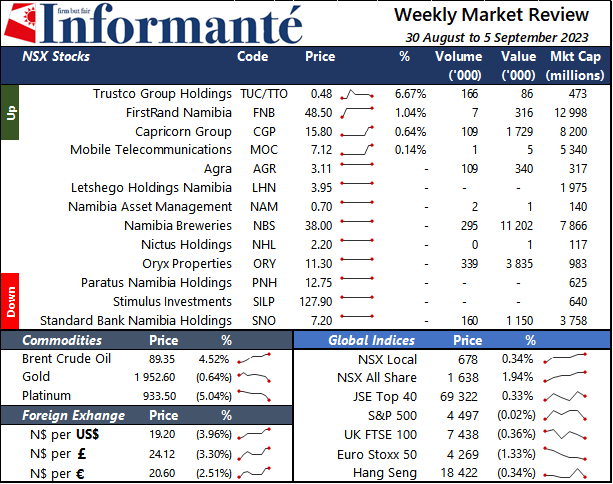
In the local market this week, the Namibian Stock Exchange (NSX) saw some noteworthy movements. The NSX Local index displayed resilience, posting a gain of 0.34% and closing at 677.8. Meanwhile, the broader NSX Overall Index exhibited more substantial growth, surging by 1.94% to reach 1637.6. As of September 5, 2023, FirstRand Namibia emerged as the largest local company on the exchange, boasting a market capitalization of N$13.0 billion. It was closely followed by Capricorn Group, with a market capitalization of N$8.2 billion, Namibia Breweries at N$7.9 billion, and Mobile Telecommunications with a market cap of N$5.3 billion. Market dynamics this week saw Trustco Group Holdings taking the lead, concluding the trading week at N$0.48 per share. This performance marked an impressive growth of 6.7%. Following suit was FirstRand Namibia, securing the second position with a closing price of N$48.5, reflecting a growth rate of 1.0%. In terms of trading volume, Namibia Breweries held the top position, with shares worth N$11.2 million changing hands during the week. Oryx Properties secured the second spot, with a trading volume of N$3.8 million. On the currency front, the local currency faced some challenges. Against the US Dollar, the Namibian Dollar experienced a decline of 3.96%, closing at N$19.20 per USD. A similar trend was observed against the British Pound, with the currency losing 3.30% and concluding at N$24.12 per GBP. Meanwhile, against the Euro, the Namibian Dollar closed at N$20.60, registering a decrease of 2.51%.
The Namibia Statistics Agency has unveiled its Trade Statistics Bulletin for July 2023, offering insights into the nation’s trade balance and trends. During the month of July 2023, Namibia’s trade balance showcased a deficit of N$3.7 billion. This figure marks a notable shift from the N$1.5 billion surplus recorded in June 2023 and the N$2.3 billion surplus noted in July 2022. Examining the specifics of trade in July 2023, the nation’s export earnings experienced a decline of 3.8 percent, moving from N$8.6 billion in the previous month to N$8.3 billion. Conversely, the import bill for the same period surged by 17.8 percent, reaching N$11.9 billion, compared to the N$10.1 billion recorded in June. Diving into the details of this trade shift, the decrease in exports of goods during July was primarily driven by declines in various sectors. Notably, ‘Copper and articles of copper’ saw a decrease of N$473 million, while the ‘Fish’ sector experienced a dip of N$349 million. Furthermore, ‘Printed matter’ saw a reduction of N$268 million, ‘Other crude minerals’ witnessed a decrease of N$86 million, and ‘Iron and steel bars’ noted a decrease of N$74 million. On the flip side, the increase in imports of goods for the same period highlighted different sectors. ‘Copper ores and concentrates’ surged by N$1.4 billion, ‘Petroleum oils’ saw an increase of N$799 million, and ‘Iron and steel bars’ noted an uptick of N$135 million. Additionally, ‘Residual petroleum products’ and ‘Civil engineering and contractors’ equipment’ experienced increases of N$103 million and N$88 million, respectively. In terms of trading partners, Botswana emerged as Namibia’s largest export market, accounting for 23.3 percent of total exports. South Africa retained its status as the nation’s largest import market, making up 37.8 percent of total imports. It’s worth noting that the majority of exports, approximately 42.3 percent, were routed through Namibia’s airports, while imports were primarily transported via road, constituting 48 percent of the total.


