


Staff Reporter
THE Chief Executive Officer (CEO) of the Namibia Investment Promotion and Development Board (NIPDB), Nangula Uaandja, has urged Namibians to be “cautiously optimistic” about the country’s oil and gas discoveries, which are expected to double the country’s Gross Domestic Product (GDP), among other benefits.
“We still need to do a few things to determine if and when we will be entering production. So, it’s great to be excited, but I think it’s also important to be cautiously optimistic as Namibians,” Uaandja said.
The CEO of NIPDB made these remarks at the two-day Oil and Gas Conference in Windhoek, which commenced on Wednesday, 16 August. During the conference, she emphasized that the oil and gas prospects carry significant promise for Namibia. Nevertheless, she pointed out that not every nation that discovers oil successfully transitions to the production phase. She underscored that several factors still need to be determined before the country can fully benefit from these discoveries, a process that is expected to span several years.
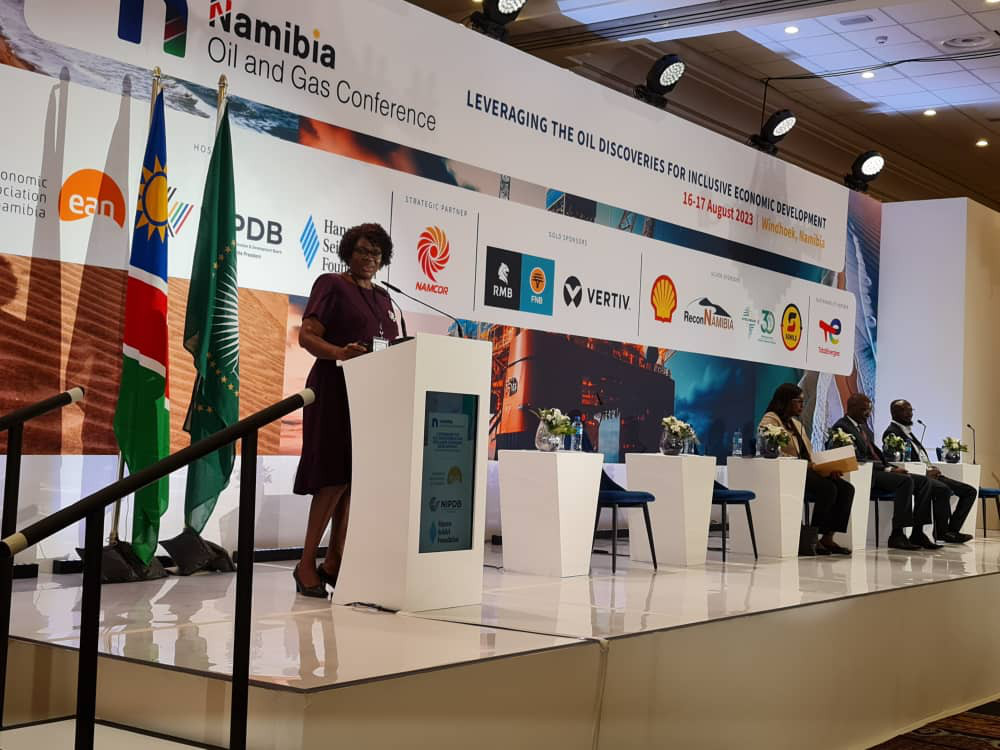
One of the key factors to be determined is the commercial viability of the discoveries. Uaandja explained that it’s crucial to assess whether the production costs can be effectively managed to compete with the prevailing price of crude oil per barrel in US Dollars. This determination hinges on comprehensive appraisal efforts, laying the foundation for full-scale production.
Considering the substantial expenses associated with data acquisition, exploration, and appraisal of the discoveries, Uaandja emphasized that Foreign Direct Investment (FDI) will also be necessary for the discoveries to succeed.
Despite the challenges, Uaandja remained optimistic about the potential impact of Namibia’s oil and gas finds. Therefore, she encouraged the public to remain cautiously hopeful and to prepare themselves for the oil and gas industry as if it is a certainty.
“That means building the necessary skills, that means understanding the value chains, that means communicating what we need to do, that means – for the government – creating enabling legislation,” she explained.
Her sentiments were echoed by Shiwana Ndeunyema, the Acting Managing Director of the National Petroleum Corporation of Namibia (NAMCOR), who highlighted the need to have a crucial public conversation surrounding the “Resource Curse”. This “curse” occurs when too much of a country’s capital and labour force is concentrated in a particular industry, limiting progress in other sectors.
“Because the sector offers significant premiums, everybody – all businesses, human resource capacity – is concentrated in the petroleum sector and suffocates other aspects of the economy essentially,” he explained.
According to Ndeunyema, this is a potential outcome with the promising oil and gas industry, which is why public discourse about this phenomenon is necessary. Nonetheless, Ndeunyema, much like Uaandja, acknowledged that the oil and gas discoveries hold the potential to significantly transform Namibia’s economic landscape. He disclosed that Namibia could rank among the top 15 oil producers by 2035, leading to a doubling of the country’s GDP per capita within a decade.
He further revealed that, according to a study commissioned by Wood Mackenzie, it is estimated that the four oil and gas discoveries made in the Orange Basin – namely Graff, Venus, Jonker, and Lesedi – are estimated to yield about 11 billion barrels of oil. Among these, Venus stands out as the second-largest global Deepwater oil discovery, harbouring 5.1 billion barrels of oil reserves.
Ndeunyema cautioned that the 11 billion barrels of oil reserves represent preliminary estimates, with more precise figures anticipated by the end of September. He said that the nation is currently in the initial phase, yielding limited value. Tangible local benefits from the oil and gas findings are expected between 2026 and 2032 during phase two, while phase three, the final phase, is projected to commence by 2032.


