


Floris Steenkamp
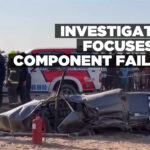
AN investigation team from the Ministry of Works and Transport’s Directorate of Aircraft Accidents and Incident Investigations is concluding their work at the scene of a fatal helicopter crash in Swakopmund. The next step will be the removal of the wreckage to a facility in Windhoek, where the investigation will focus on the technical details. However, early indications suggest that the accident was caused by a critical component failure in the main rotor, specifically the pitch link.
The crash occurred on Monday afternoon and claimed the lives of 29-year-old Dirk von Weidts and 54-year-old pilot Jacques Jacobs.
The helicopter involved in the crash is a Robinson-44 with the call sign V5-HGG. It is currently registered in the name of an individual residing in Mariental, southern Namibia.
Jacobs, who was qualified to perform test flights after repairs and maintenance, was flying at a height of 450 feet when a loud booming sound was heard and the helicopter crashed, with the tail section completely severed from the main fuselage.
Von Weidts was part of a team that performed repairs and maintenance on the helicopter in recent months. He was working towards becoming an aircraft maintenance engineer later this year and participated in the work to build his portfolio. He recently qualified as an aviation security manager and was known for his passion for aviation.
Similarly, Jacobs was described as an exceptionally skilled pilot, flight instructor, and test pilot.
Both individuals were highly respected in the aviation community and were known for their meticulousness and high standards. It is not surprising that a critical component failure led to the crash, which was beyond the control of Jacobs in those split seconds.
An air accident investigator, who is not involved in this investigation, reviewed photographs and videos of the crash and indicated that the pitch link failure was indeed the cause. The detachment of the tail section and the disappearance of the main rotor blades are tell-tale signs. The loud booming sound suggests that the main rotors hit the tail section.
However, the investigator cautioned that although identifying the cause may be relatively straightforward, determining what led to the component failure will be a more challenging task. This process could take months, and until the investigators are ready with a report, it remains speculative.
The investigator’s information was corroborated by a helicopter owner and experienced pilot who requested anonymity as they were yet to share crucial information with the investigators.


