Staff Reporter
THE leader of the Landless People’s Movement (LPM), Bernadus Swartbooi, has applauded efforts made towards education in the country, adding that the government is addressing the shortcomings in Namibian schools.
Swartbooi further called upon all members of parliament to come on board as the education of the Namibian child should be a collective responsibility.
He made these remarks while sharing his motion on the post Covid-19 challenges in the education sector, inclusive of primary and secondary schools.
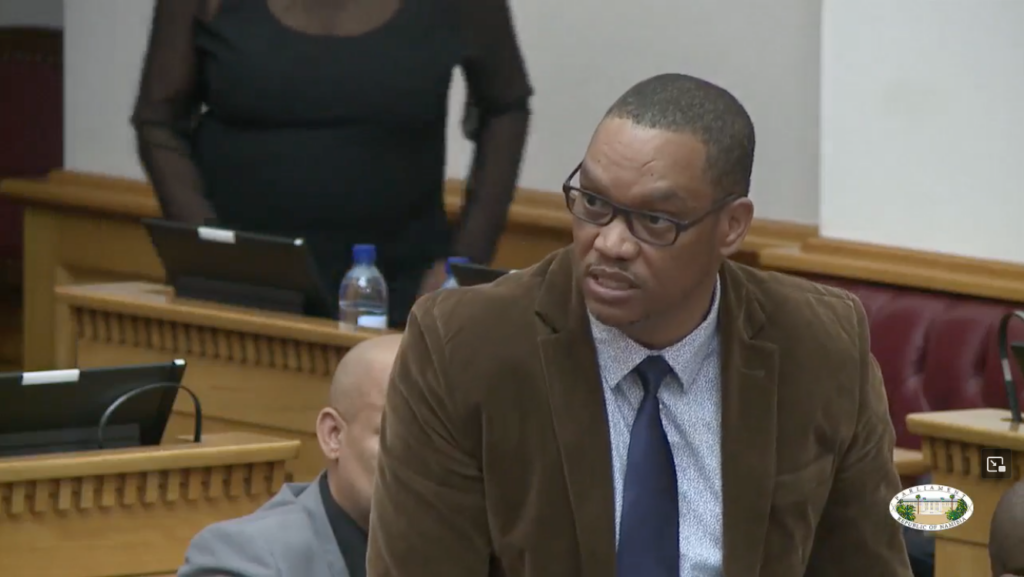
“I say this time and again, government alone cannot solve all the problem in isolation. It will take all stakeholders’ support to improve the situation in education as far as infrastructure in schools and hostels is concerned,” Swartbooi said.
THE LPM leader said that, as indicated in the report on the outcome of a meeting with President Hage Geingob on the status of the Senior Secondary Certificate Ordinary level (NSSCO) and Senior Secondary Certificate Advanced Subsidiary (NSSCAS), the Ministry of Education, Arts and Culture has identified infrastructural gaps as one of the factors that negatively affect teaching and learning, contributing to learners’ undesirable performance.
He explained that this rendered the education sector less resilient against the impact of Covid-19, resulting, for example, in disruptions of teaching and learning to adhere to Covid-19 safety measures, especially social distancing.
“We have also established that in primary education this gap (infrastructure) is causing overcrowding in classrooms,” Swartbooi said.
He added that the ministry’s remedial measures to address the shortage of classrooms include the fast-tracking of school infrastructural development through the Accelerated Infrastructure Development Plan (AIDeP), which identifies and cost the immediate ministerial infrastructure needs.
“It is through this plan that targeted funds will be allocated to all regions based on respective regional classroom shortages or infrastructure needs, as was elaborated in our budget introduction. We have a shortage of 4 500 classrooms, understandably we cannot construct all those classrooms in one year, but we have a clear plan to add those 4 500 classrooms over a period of seven years. The ministry took the shortage of classrooms as an urgent educational need. It is for this reason that in the 2023/2024 Financial Year, we purposefully allocated an amount of N$213 million towards the construction of additional classrooms,” he summarised.
Swartbooi said that the N$213 million would enable the ministry to construct additional 510 classrooms and 70 ablution facilities because as the number of classrooms at a particular school grow, so does the need for additional ablution facilities.
According to the 15th School Day Statistics (2022), the ministry maintains a total number of 1 709 government schools, with a total learner population of (839 579).
Swartbooi noted that, in addition to infrastructure needs, the recent changes in the curriculum saw the addition of skills-based/pre-vocational subjects, which have created additional infrastructure needs to accommodate such subjects at school level, including teaching and learning materials, workshops and specialised classrooms, e.g. home ecology, hairdressing, etc.
He, however, said that the immediate priority is to address the existing school, infrastructure needs. This includes classrooms, ICT resources and computer laboratories, pre-vocational workshops and science laboratories.
With respect to the granting of learners who were unsuccessful to return to schools, the Ministry of Education, Arts and Culture has, as per Circular 1/23 granted permission, for candidates who did not meet the requirements to proceed to the NSSCAS to be given an opportunity to repeat NSSCO (grade 11) full time, provided that there is space available at schools and the learners are18 years or younger on the 1 January 2023.