


Staff Reporter
THE Minister of Finance, Iipumbu Shiimi, tabling the mid-term budget review said that the increase in civil servants’ salaries, which cost government a total of N$1,3 billion, pushed expenditure up significantly, however upward trends in revenue enabled government in absorbing this expense and also catering to additional budgeting needs of N$ 4 billion in the mid-term budget.
This revenue increment has also marginally decreased the budget deficit, according to the finance minister.
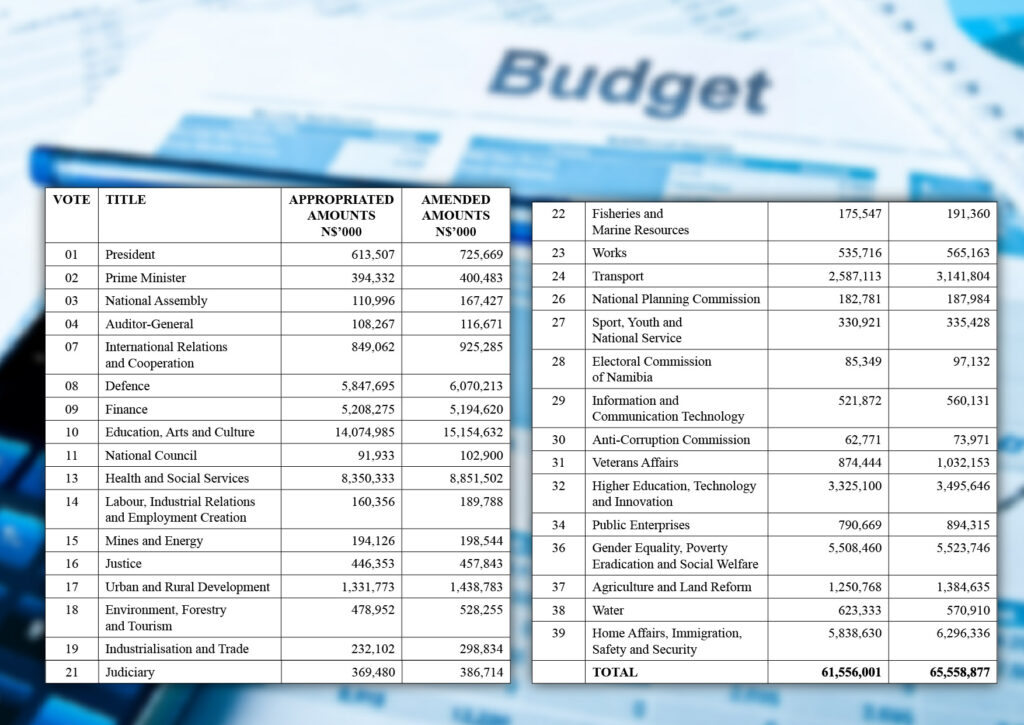
In February 2022, Shiimi tabled a N$61,6 billion budget, consisting of N$56,6 billion in operational expenditure and N$5 billion for the development budget.
In the process of compiling this Mid-year Budget Review, the finance minister said that an additional expenditure requests to the tune of N$4 billion were received.
At the same time, consideration of the additional cost of N$1,3 billion for the salary and benefit adjustments of civil servants as agreed to with the unions had to be made.
Shiimi explained that due to the strong performance in revenue collections year-to-date, government has revised total revenues for the 2022/2023 financial year upwards by N$4,4 billion.
He attributed the positive adjustments in revenues for 2022/23 on strong collections year-to-date, mainly on the categories of Income Tax on Individuals, corporate tax on both diamond mining companies as well as non-mining companies, value-added tax (VAT) and dividends from entities such as DebMarine Namibia.
The finance minister added that the budget review exercise further identified potential savings for re-allocation across votes to the tune of N$387,3 million.
The development budget is increased by an additional N$497,7 million to settle outstanding invoices and cater for potential shortfalls on critical ongoing projects to ensure continuity and avoid further penalties on road projects. Other notable allocations include covering the shortfall on the Land Servicing Programme as well as the extension of the apron at the Hosea Kutako International Airport.
A total of N$747,4 million of additional personnel expenditure were also granted. A bulk of it to the Votes of Health and Social Services as well as Education, Arts and Culture to cater for projected shortfalls on recruitment. Shiimi said that the Auditor General has flagged persistent overspending by the two votes in previous financial years, primarily due to underbudgeting.
Overall, the operational budget has been increased from N$56,6 billion to N$60,1 billion. Similarly, the development budget has been adjusted upwards from N$5 billion to N$5,5 billion.
At the half-year mark, the total debt stock stood at N$136,2 billion, equivalent to 69% of the Gross Domestic Product (GDP). This is an upward trend from the N$126,1 billion, equivalent to 66,9 % of GDP recorded at financial year that ended March 2022.
On balance, Shiimi stated that the nominal budget deficit is reduced from N$11,1 billion to N$10,6 billion. As a ratio of GDP, the deficit is reduced marginally from 5,6% to 5,3%. Shiimi stated that accordingly, the borrowing plan for the remaining months of the financial year will be revised down to reflect this adjustment.
Shiimi also said that expenditure is projected to grow by 2,4% on average over the Medium-Term Expenditure Framework (MTEF) to reach N$80,0 billion in FY2025/26.
“The high public debt levels continue to be central in the fiscal policy considerations over the medium term. As affirmed in the previous budget, government maintain the commitment to redirect much of the revenue increases in the coming years, as the economy recovers, towards debt,” Shiimi concluded.
The FY2022/23 Appropriation Amendment Bill and the corresponding resource re-allocation across the various sectors and programmes.


