Staff Reporter
THE conflict between Russia and Ukraine is one of the main factors impacting Namibia’s economy at the moment.
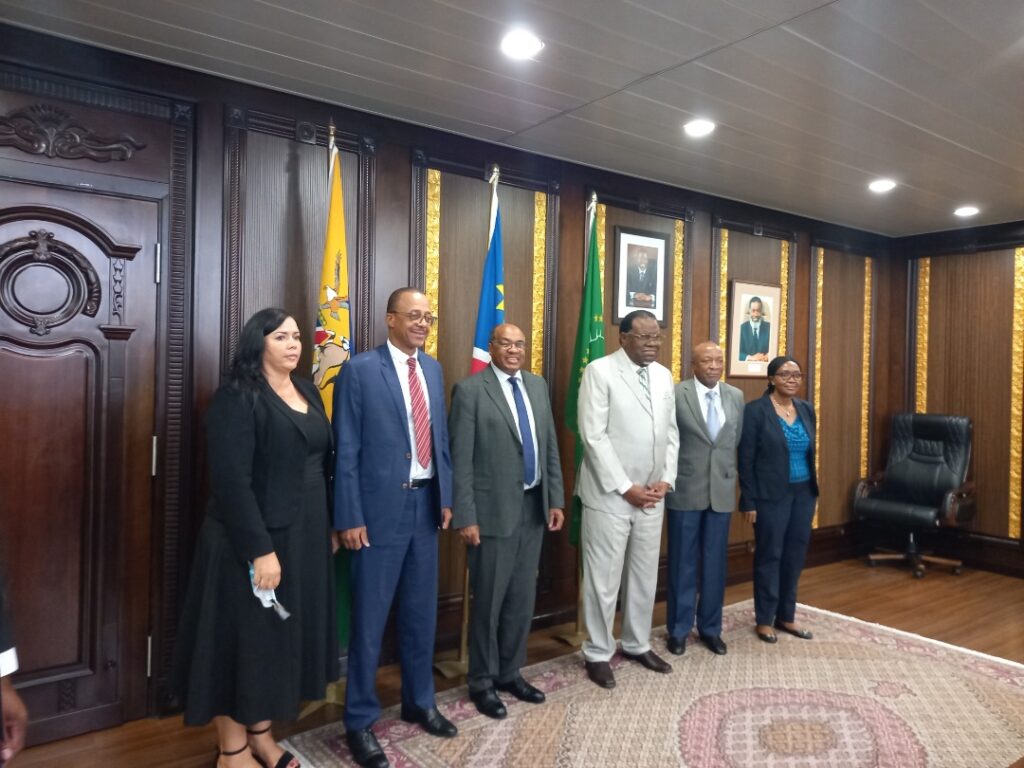
This was discussed during a courtesy call by Johannes !Gawaxab, Governor of the Bank of Namibia (BoN) and the BoN Executive leadership on President Hage Geingob on Wednesday.
The Deputy Governor of BoN, Ebson Uanguta, said Namibia needs to recognise that those two countries, especially Russia, is not a small player in a number of global commodity productions.
“If you take oil, Russia contributes almost around 12% of the global production. For gas, Russia contributes around 16,6% of the global exports, wheat Russia contributes around 11%,” Uanguta explained.
According to the Deputy Governor, the Russian-Ukraine conflict might also affect the country’s domestic growth, which was projected to improve in2022 and 2023.
This is because the projected domestic growth is largely supported by the better growth prospects of the diamond mining industry. However, considering the fact that Russia is also a key player in diamond mining, the Deputy Governor stated that the situation requires monitoring.
Uanguta further stated that the ongoing Russian-Ukraine war could have an impact on the country’s inflation rate as well. According to him, the inflation rate was expected to be around 4,4% this year, but could increase as a result of the conflict.
“With the new development, especially with oil, it’s likely that the outcome of inflation by the end of the year is going to be different,” he explained.
The impact of the Russia-Ukraine conflict came at a time when the country was already faced with a number of economic challenges, which primarily originated from the Covid-19 pandemic.
However, according to the Governor of the BoN, Johannes !Gawaxab, the Bank is doing well despite the challenges presented by the pandemic.
“We really have got the right systems, processes and people within the bank and that enables us to be probably one of the (most) effective and efficient institutions that we have got in the country,” !Gawaxab added.
The Governor also announced that the Bank will undergo a digital transformation as part of a new three-year strategy, which will mainly focus on digitising the banking operations in order to improve efficiency.
“If you need to survive in this environment, you need to evolve. We are supervising banks and if we don’t evolve and create certain capabilities and skill sets, we’re probably not going to be able to do that effectively,”!Gawaxab stated.
According to the Bank’s recently appointed second Deputy Governor, Leonie Dunn, efforts in relation to the new strategy will be rolled out to modernise the financial system. She stated that focus will also be applied to use digital capabilities to include underserved rural communities and to bring the informal economy into the formal economy.
“Our biggest enabler on this three-year journey is for the digital transformation. We are going to harness the opportunities it avails and remain confident that our outputs will assist Namibia to indeed prosper from our efforts,” Dunn stated.
President Hage Geingob acknowledged the prevalence of the digital divide between rural and urban communities in the country. Moreover, he said that he welcomes the new three-year strategy as “we have to catch up with the world”.