
Staff Reporter
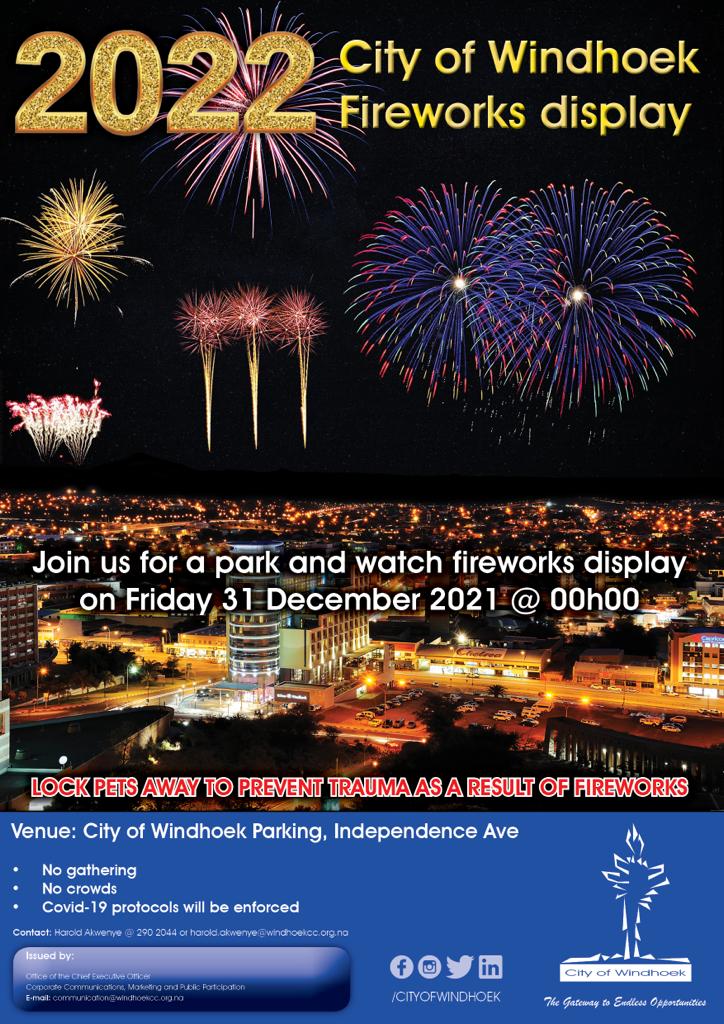
THE City of Windhoek has opted for a Park and Watch fireworks display on 31 December to ring in New Year.
This ensures no crowds or gatherings, in line with Covid-19 protocols.
The CoW advised pet owners to keep their animals locked away safely to prevent possible trauma because of the noise.
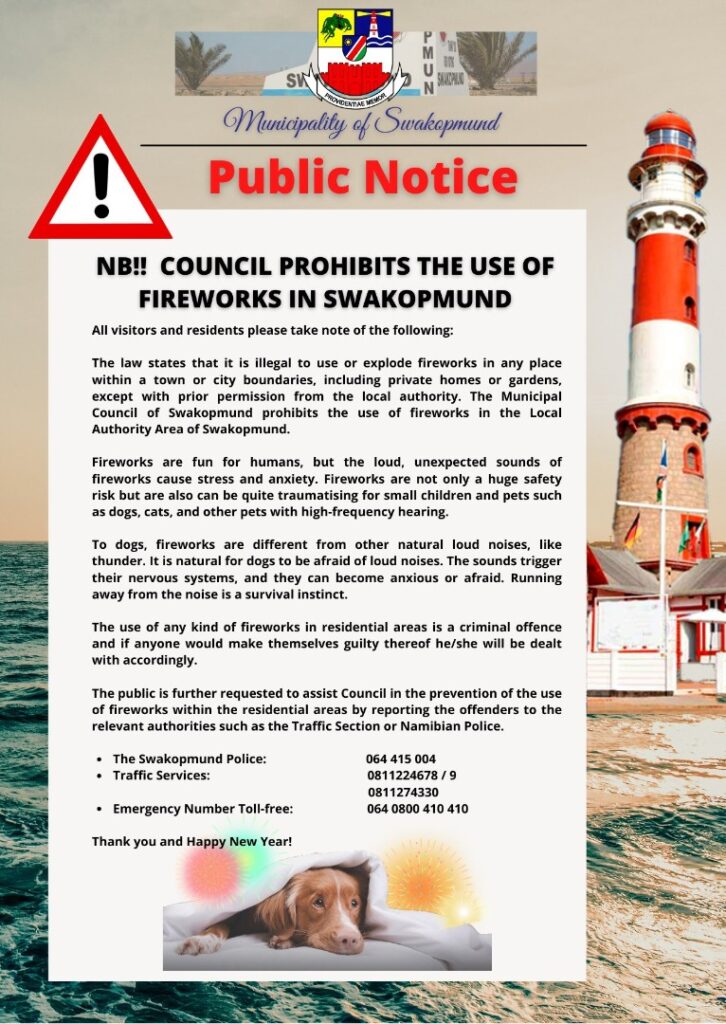
The Swakopmund Municipality issued a notice stating it is against the law to set off fireworks within city or town boundaries, including at private homes or in gardens, without prior permission from the local authority.
In many countries, New Year’s Eve is celebrated at evening and outdoor parties, where people dance, eat, drink, and watch or light fireworks.
However, in the years since the Covid-19 pandemic started, great firework events had been cancelled or scaled-down.
This year, the world-famous New Year’s Eve celebrations in New York City’s Times Square will see a limited number of fully vaccinated spectators and everyone has to wear a mask, according to the Gettysburg Times.
Major cities in Europe, where the spread of Omicron has been startling, have announced all firework plans are cancelled.
Fireworks remain a controversial issue for many, because of the stress it creates for animals and the fire damage it can cause.
Many historians believe that fireworks were originally developed in the second century B.C. in ancient Liuyang, China.
The first natural firecrackers were bamboo stalks thrown in a fire, exploding with a bang because of the overheating of the hollow air pockets in the bamboo.
The Chinese believed these natural firecrackers would ward off evil spirits.
Legend has it a Chinese alchemist years later mixed potassium nitrate, sulfur and charcoal to produce a black, flaky powder – the first gunpowder.
This was poured into hollowed-out bamboo sticks, and later stiff paper tubes, forming the first man-made fireworks.
Fireworks made their way to Europe in the 13th century and by the 15th century they were widely used for religious festivals and public entertainment.
The Italians were the first Europeans to manufacture fireworks.
European rulers were especially fond of the use of fireworks to enchant their subjects and illuminate their castles on important occasions.
Early settlers in the United States brought their love of fireworks with them to the New World and made it part of the first Independence Day – a tradition that continues every 4th of July.
In the late 18th century, politicians used displays to attract crowds to their speeches.
In Britain, Guy Fawkes Night is celebrated with fireworks on 5 November.
Guy Fawkes was a member of a group of provincial English Catholics involved in the Gunpowder Plot of 1605, a failed attempt to blow up the Houses of Parliament in London.
Bonfires were accompanied by fireworks from the 1650s onwards.
In modern times, pyrotechnical competitions involving fireworks are held in many countries.
The most prestigious competition is the Montreal Fireworks Festival, annually held in Quebec, Canada.
Another one is Le Festival d’Art Pyrotechnique held at the Bay of Cannes in Côte d’Azur, France.
The World Pyro Olympics is an annual competition amongst the top fireworks companies in the world. It is held in Manila, Philippines. The event is one of the largest and most intense international fireworks competitions.
Despite many cities and countries cancelling New Year’s fireworks, Ras Al Khaimah in the United Arab Emirates is set for a spectacle on 31 December that aims to clinch two Guinness World Records, namely the Most Remote Operated Multirotors/Drones Launching Fireworks Simultaneously and the Highest Altitude Multirotor/Drone Firework Display.
According to NationalNews.com, more than 15 000 fireworks effects, over 130 sea pontoons and a fleet of hundreds of pyrotechnic drones will be part of the display.