


Niël Terblanché
NAMIBIA will be one of the very few countries on Earth that will be able to lay claim on a patch of Martian dust after the National Aeronautics and Space Administration of the United States of America (NASA) honoured the late Dr. Japie van Zyl by naming the ‘airfield’ where the Ingenuity Mars Helicopter will be launched after the country’s renowned space explorer.
Before his death in August 2020, Dr. van Zyl was not only part of planning the Perseverance rover’s mission to Earth’s neighbouring planet, but he was also the driving force behind the design and development of the very first rotor aircraft that will fly in the thin Martian atmosphere.
The Ingenuity Mars Helicopter is expected to take flight on the Van Zyl Overlook ‘airfield’ in about a week’s time.
Besides having a Namibian hand in its design the small electric-powered helicopter also has a tiny piece of cloth that was used to cover the wooden spars of the Wright Flyer built into it. The Wright Flyer was the first aircraft to fly under human control and mechanical power on Earth, 118 years ago.
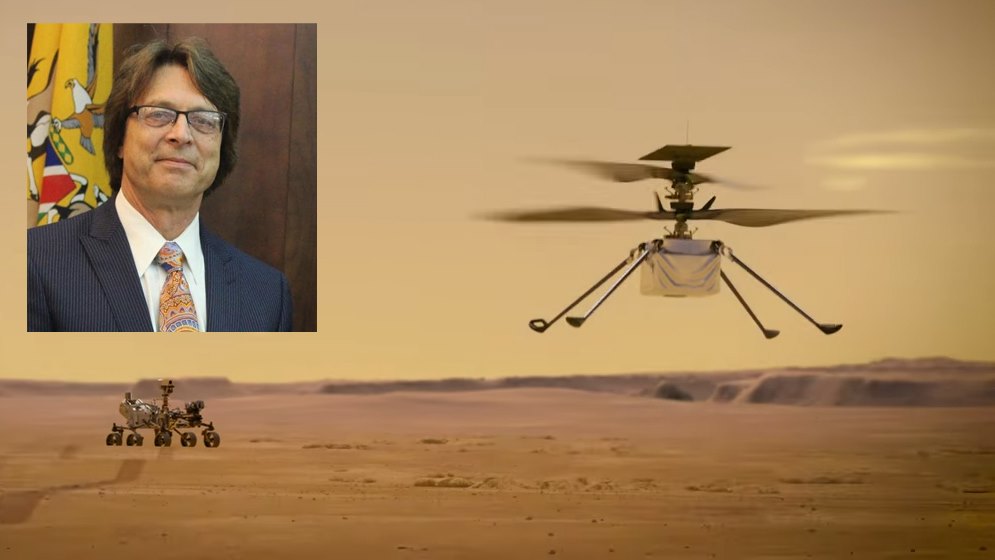
Ingenuity is currently still attached to the belly of the Perseverance rover, which touched down on the surface of Mars on 18 February 2021.
Perseverance is currently in transit to the Van Zyl Overlook ‘airfield’ where Ingenuity will attempt its first flight. The rover is scheduled to drop Ingenuity in the middle of the 10×10 metre ‘airfield’. Like any other airfield on Earth, the Van Zyl Overlook was chosen for its flatness and absence of obstructions.
Once Perseverance is situated correctly, the helicopter, which is currently attached to the belly of the rover, will be deployed on the surface of Mars. Ingenuity will have 30 Martian sols, (31 Earth days) to conduct its test flight campaign.
Flying in a controlled manner on Mars is infinitely more difficult than flying on Earth because the red planet has an atmosphere that is 99% less dense and gravity that is only one-third of that of the Earth’s.
Dr. van Zyl, died in the Pasadena Huntington Hospital in the United States of America on Namibia’s Heroes Day last year after suffering a severe heart attack.
The space scientist was born in Outjo and spent his childhood years under the night sky of Opuwo where his interest in space peaked for the first time.
After leaving school he went to the University of Stellenbosch, where he in 1979, completed an electronics engineering degree with cum laude honours.
In 1982 he moved to California where he completed an MSc degree and Ph.D. in electronic engineering at the California Institute of Technology (Caltech) in 1986. He joined the Jet Propulsion Laboratory (JPL) as a researcher shortly after completing his studies.
The late Dr. van Zyl is widely regarded as one of the pioneers of space exploration and became especially famous for taking the lead on various NASA programs that were launched to explore the solar system.
Upon his retirement from the executive council of the Jet Propulsion Laboratory as Director of Solar System Exploration in September 2019, Dr. van Zyl received the prestigious Outstanding Public Service Medal Award from NASA for his trail-blazing work and contribution to science.
Dr. van Zyl distinguished himself by the significant contributions he made to NASA during his 33-year career, while simultaneously achieving world renown for his research in radar polarimetric scattering and image analysis.
During his career, Dr. van Zyl also managed the operations of all JPL Earth Science missions and instruments developed for other NASA Centers and international space agencies.
In recent years, he has defined, formulated, acquired, and implemented all missions in the solar system. He consistently delivered successful missions that produced trailblazing results.
President Hage Geingob on several occasions lauded the cutting-edge and exemplary work of Dr. van Zyl in space science and encouraged young Namibian scientists to follow in his footsteps.


