


Nël Terblanché
FOUR additional localities have been created where residents of Windhoek can submit specimens for COVID-19 testing.
The Minister of Health and Social Services, Dr. Kalumbi Shangula, said that although testing capacity has been increased with the addition of more laboratory facilities and equipment it was observed the congestion of the clinic in Robert Mugabe Avenue where most of the testing in the capital is done.
“The Ministry has noted with concern, sporadic congestion at the Robert Mugabe Avenue Clinic, which is dedicated as COVID-19 screening facility. In this regard, the Ministry has implemented measures to decongest the facility, by establishing four additional screening points around Windhoek where samples for COVID-19 testing can be collected. The points are located in different constituencies around the City of Windhoek, to minimise long distances that members of the public have to travel to access these services,” he said.
Expanding on the congestion issue, Dr. Shangula said that it is strictly discouraged for employers to send their employees to the Robert Mugabe Clinic to collect their results because it created further congestion which negates public health measures.
“An alternative way is being explored for the disclosure of negative results that will not require the presence of an individual. Positive results will continue to be disclosed in person with accompanying psychosocial support,” the health minister said.
With regard to the extension of Stage 3 of the State of Emergency and the widening of the nightly curfew to include all of Namibia, Dr. Shangula said the new COVID-19 response measures will come into effect on Sunday, the 30 August 2020.
The health minister also addressed other aspects of the national response that have occupied public discourse in the past weeks. He said before the latest response to the pandemic was finalised Cabinet has been informed thoroughly about these matters.
Safe burials for Covid-19-related deaths.
The COVID-19 pandemic has affected and changed all aspects of life. This includes the way we grieve the loss and burial of loved ones, especially those who die as a result of the COVID-19. There is now increased fear and anxiety in communities regarding this matter. For this reason, the Ministry of Health and Social Services has compiled a document, setting out the procedures and legal requirements related to the burials of those whose deaths are attributed to COVID-19.
He added that the burial of people, who succumb to COVID-19, must be seen in the context of legal requirements regarding the handling of the human remains of those who succumb to all other notifiable infectious diseases.
“In this regard, these requirements relate to the various stages of the process, namely, immediately after death, transportation of the body, the burial or funeral process,” he said.
According to Dr. Shangula, all the stages relevant to Infection Prevention and Control measures must be adhered to in order to prevent infection and transmission of infectious agents. He said the relevant legal frameworks in this regard are the provisions of the Public and Environmental Health Act of 2015, the Regulations issued under the State of Emergency declared on account of the COVID-19 pandemic and the applicable Standard Operating Procedures.
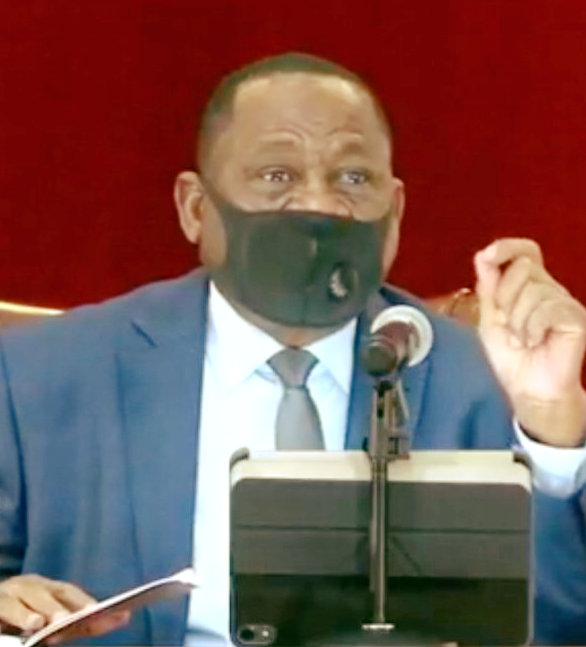
Dr. Shangula said that all the legal provisions have been taken into account and the decision that all COVID-19 burials are handled by the State, Cabinet at its sitting this week directed that all the instances involved in the burials of those who succumb to COVID-19, should ensure that:
• The conduct of the burials must be in strict conformity with the adopted safe burial guidelines;
• The conduct of safe burials considers the cultural and religious norms of the families, and allow the family to practice the required rituals;
• The covering of graves with mechanical ploughs be discontinued, to ensure dignified burials for the deceased;
• The safe burials must not be conducted in haste, but within the time as would be agreed with the families.
The tenets behind the concept of a safe burial are that the handling of the body must be kept to the minimum. In this regard, bodies should be buried closest to where the death occurred.
“Thus, transportation of bodies is not permissible,” he said.
The Ministry is fully committed to ensuring that its actions do not cause more anguish to those who are already grieving.
“It is for this reason that we appeal for full co-operation and understanding of all stakeholders in carrying out this sensitive activity. Our officials will continue to do their best to conduct these processes in a manner that does not lead to feelings of hostility and animosity for families and loved ones of the deceased,” he said.
Dr. Shangula said that at the same time, it is important to note and appreciate that the only reason for the enforcement of these measures is to protect the health and well-being of the nation. He said that the improper handling of the human remains of persons who die of infectious disease can lead to great tragedy.
“We do not wish that one funeral breeds more funerals. For this reason, everything that needs to be done must be done to prevent any infections. We, therefore, count on all Namibians for their understanding and co-operation,” he said.
Post-humous swabbing of human remains
Dr. Shangula also gave more clarification on the posthumous swabbing of COVID-19 suspected deceased. He said that given the virulent nature of this new coronavirus, it is vital to be certain whether or not a deceased person is infected with COVID-19.
He added that it is necessary because the infection status will determine how the body of the deceased will be handled so that in the case of positive results, and further infection can be prevented.
“It is for this reason that, a clinical decision is made either to collect a sample or not from a deceased. This is done on advice from health professionals on the ground. It is, however, discouraged that bodies be re-swabbed,” he said.
Autopsies
“With respect to autopsies, our law and recommendations from the WHO do not encourage autopsies, except in highly exceptional circumstances, where it is required to determine the actual cause of death,” the health minister said.
Cremation
He said that there have also been questions regarding cremation.
“The bodies of those who succumb to COVID-19 may be cremated. However, this service is currently only available in Windhoek. Cremation is the choice and the responsibility of the family and not the State. The ashes can be buried in the usual manner,” he said.
COVID-19 Vaccine
According to Dr. Shangula, the subject of a COVID-19 vaccine has also become topical.
“On this, I wish to state that Namibia has been engaging the international community regarding the development of a COVID-19 vaccine in recent months and weeks. Through the COVAX Facility, we have participated in several meeting and interactions on this matter. More information will be provided to the public in the coming weeks through regular updates on this process. As we pursue this matter, we are motivated by one thing and one thing only: to ensure that when a safe and effective vaccine becomes available, the Namibian people should be able to access it,” he said.
He said in the meantime people will have to adjust the way they live for now. He said the new rules with regard to the State of Emergency as announced by President Hage Geingob are aimed at engendering behavioural change.
“We need to and we must alter behaviours that propagate the transmission of the coronavirus. We have to take our destiny in our own hands as far as possible. The only “vaccine” currently available is a combination of social distancing, wearing of masks in public places, frequent hand washing and sanitizing. Limiting unnecessary travel makes this “vaccine” even more effective,” he said.
COVID-19 Accountability Report
The health minister said the Government has allocated and availed significant resources for the COVID-19 national preparedness and response, administered mainly by the Ministry of Health and Social Services. “The Ministry has finalized a comprehensive Accountability Report which will be submitted to Cabinet. It covers the period from 1st April 2020 to 24 August 2020,” he said.
Dr. Shangula said that a panel discussion on the niggling issues and other related matters will take at the National COVID-19 Communication Centre, where more information will be given and where members of the public will be able to ask questions by phoning in.


