
Niël Terblanché
WITH most of Namibia’s water reservoirs at critically low levels because of the worst drought in decades the national water utility company has been tasked to study the feasibility of a desalination facility that would be able to supply potable water to the central parts of the country.
Barely five months after the acting pro-vice chancellor for research, innovation and development at the University of Namibia, Professor Frank Kavishe, suggested that the country needs at least three desalination plants to address national water shortage the process has progressed to the point where a feasibility study and an environmental impact assessment process has been launched to study the viability of such a project.
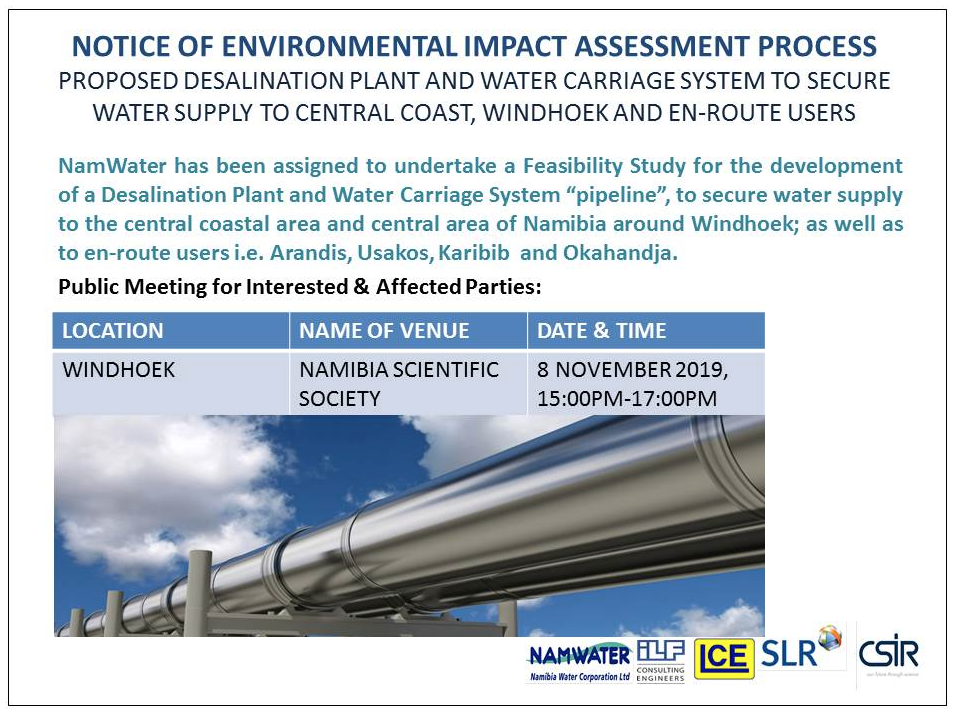
NamWater has been assigned to undertake a feasibility study for the development of a desalination plant and water carriage system or pipeline to secure water supply to Windhoek as well as the central coastal area. The feasibility study will also include the towns that such a pipeline would pass en route to the central area of Namibia.

The idea took root during the commissioning of a small solar-powered desalination plant at the Henties Bay campus of Unam that is able to produce 3 000 litres of potable water an hour, enough to irrigate three hectares of land or meet the needs of approximately 300 families per day.
At the time Professor Kavishe said because of diminishing rain fall and recurring droughts as a result of climate change, water scarcity in the country has become a harsh reality.
“Unpredictable rainfall is not just affecting water levels in dams, the water table underground is also diminishing. We need a different approach to find water resources. Namibia has the advantage of a 1 500 kilometre long coastline and plenty of renewable energy sources such as solar, waves and wind. If we have extended droughts, the whole of Namibia will have problems.” he said.
The professor was of the opinion that desalination plants at the mouth of the Kunene River will be able to supply the northern regions, while such facilities at spots on the central and southern shoreline will be able to supply communities in corresponding areas of the hinterland.
In this regard NamWater has called on Namibians that might be interested or affected by such a project to attend a public meeting that will be held at the Namibia Scientific Society in Windhoek later today. The meeting is scheduled to start 15:00.